One influential pair
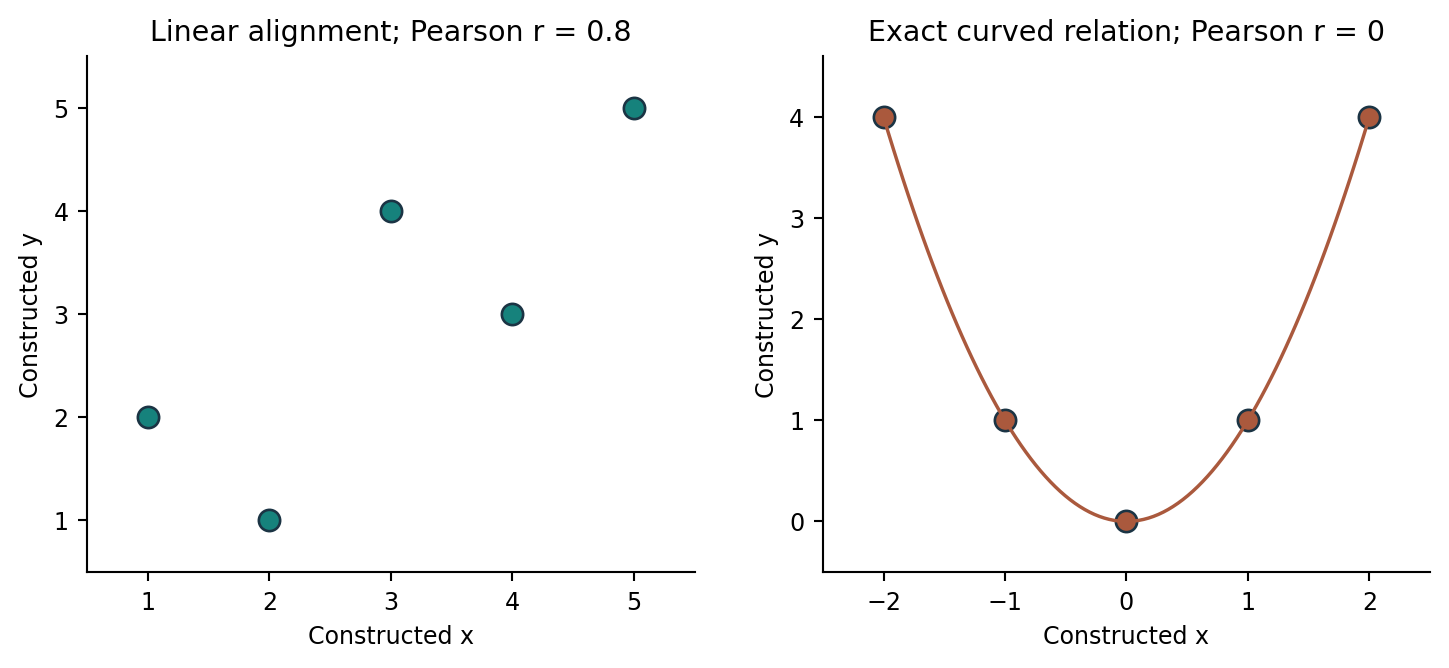
The first four pairs stay fixed: (1,2), (2,1), (3,4), (4,3). Change the fifth response and compare distance with order.
Pearson
Spearman
Kendall-a (no ties)
Choose a common case mix
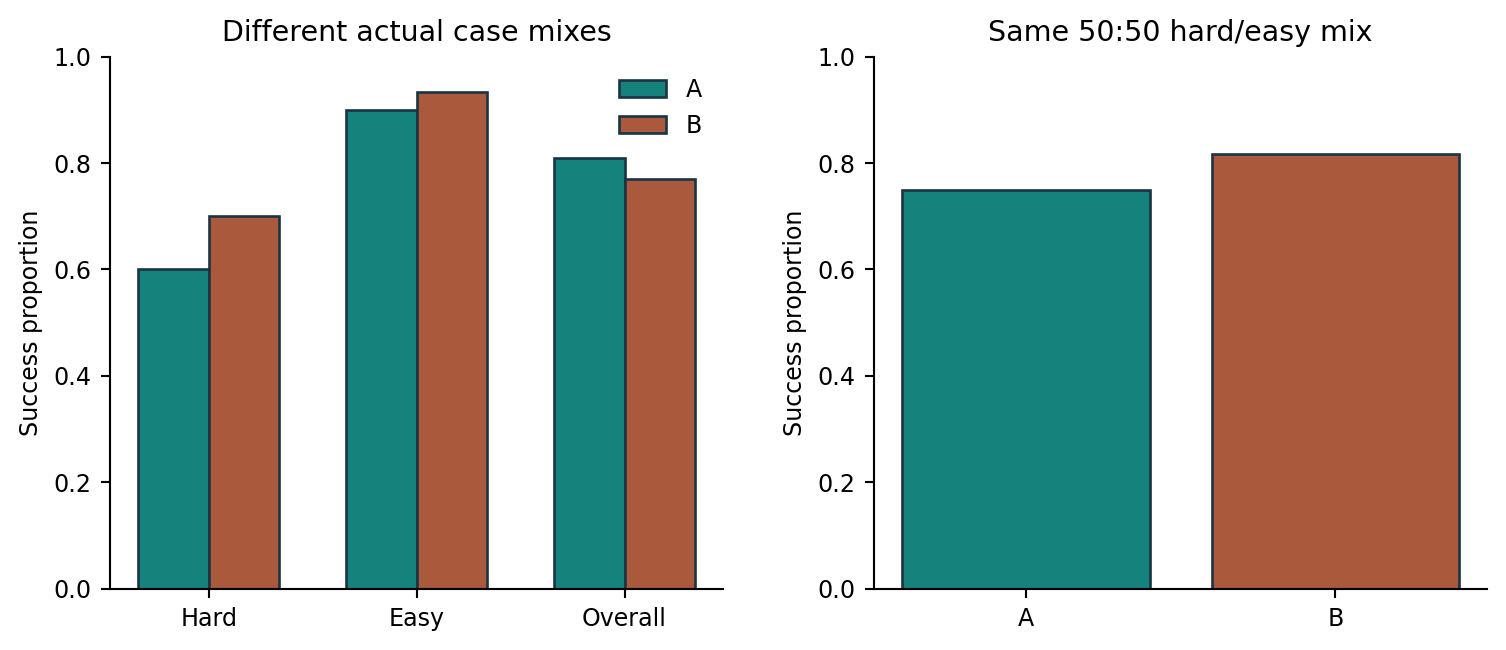
A succeeds in 18/30 hard and 63/70 easy cases. B succeeds in 49/70 hard and 28/30 easy cases. Give both the same target mix.
A under target mix
B under target mix
Raw mixes: A 81%, B 77%
Choose a target weight from a real population, not a preferred winner.
Look beneath a number
Write a short practice report
- Define one pair and its unit.
- Inspect the scatterplot before choosing a coefficient.
- Record missing pairs, time window, groups and measurement resolution.
- Explain one pattern your chosen measure could miss.
- Keep the conclusion descriptive unless the design supports cause.
Inspect the work.
Read the programs, run them in your own environment, and compare the results. The captured output records the chapter’s checked practical run; changing an input may change its answer.
Python association_lab.py
"""Executed, dependency-free numerical checks for Chapter 7. Invented data only."""
from math import sqrt, log2
from itertools import combinations
from statistics import mean

def pearson(x,y):
    ax=mean(x); ay=mean(y)
    num=sum((a-ax)*(b-ay) for a,b in zip(x,y))
    den=sqrt(sum((a-ax)**2 for a in x)*sum((b-ay)**2 for b in y))
    return num/den if den else None

def ranks(x):
    values=sorted(set(x)); out=[]
    for v in x:
        p=[i+1 for i,t in enumerate(sorted(x)) if t==v]
        out.append(mean(p))
    return out

def kendall_a(x,y):
    pairs=[(x[j]-x[i])*(y[j]-y[i]) for i,j in combinations(range(len(x)),2)]
    return (sum(z>0 for z in pairs)-sum(z<0 for z in pairs))/len(pairs)

x=[1,2,3,4,5]; y=[2,1,4,3,5]
assert abs(pearson(x,y)-.8)<1e-12
assert abs(pearson(ranks(x),ranks(y))-.8)<1e-12
assert abs(kendall_a(x,y)-.6)<1e-12
print('Five pairs: Pearson %.6f; Spearman %.6f; Kendall-a %.6f' % (pearson(x,y),pearson(ranks(x),ranks(y)),kendall_a(x,y)))
y2=[2,1,4,3,50]
assert abs(pearson(x,y2)-.7284)<.001
print('Extreme last y: Pearson %.6f; Spearman %.6f; Kendall-a %.6f' % (pearson(x,y2),pearson(ranks(x),ranks(y2)),kendall_a(x,y2)))
u=[-2,-1,0,1,2]; q=[t*t for t in u]
assert abs(pearson(u,q))<1e-12
print('Exact U-shape: Pearson %.6f' % pearson(u,q))
a_h,a_e=18/30,63/70;b_h,b_e=49/70,28/30
assert (18+63)/100==.81 and (49+28)/100==.77
assert abs(.5*a_h+.5*a_e-.75)<1e-12
assert abs(.5*b_h+.5*b_e-49/60)<1e-12
print('Channels: overall A %.2f B %.2f; common 50:50 A %.6f B %.6f' % (.81,.77,.5*a_h+.5*a_e,.5*b_h+.5*b_e))
phi=(12*7-8*3)/sqrt(20*10*15*15)
assert abs(phi-.282842712)<1e-8
print('Reminder pilot: RD %.2f RR %.2f OR %.2f phi %.6f' % (.6-.3,.6/.3,(12*7)/(8*3),phi))
partial=(.7-.8*.75)/sqrt((1-.8**2)*(1-.75**2))
assert abs(partial-.251976)<1e-5
print('Partial correlation: %.6f' % partial)
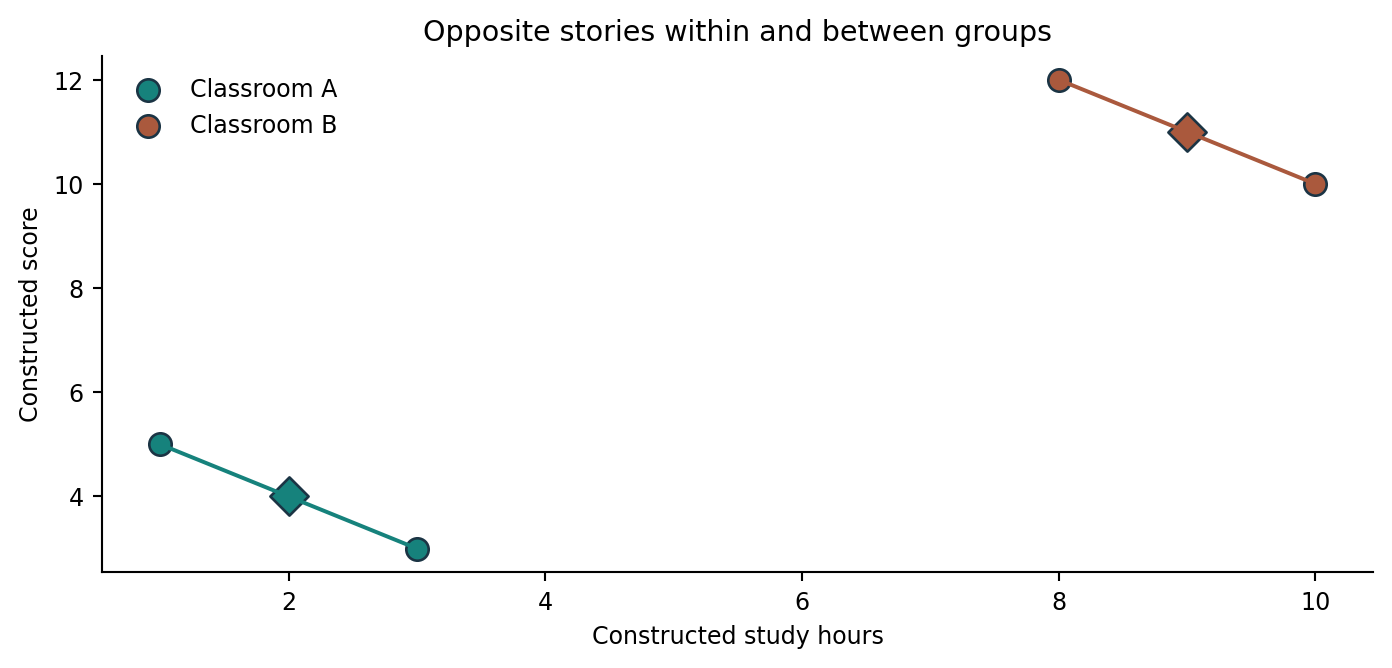
ca=[[1,5],[2,4],[3,3]];cb=[[8,12],[9,11],[10,10]];pool=ca+cb
assert pearson([a for a,b in ca],[b for a,b in ca])==-1
assert pearson([a for a,b in cb],[b for a,b in cb])==-1
assert pearson([a for a,b in pool],[b for a,b in pool])>0
print('Classroom within: -1, -1; pooled: %.6f' % pearson([a for a,b in pool],[b for a,b in pool]))
scale_x=[1,2,4,8,16];scale_y=[1,2,3,4,5]
assert abs(pearson([log2(t) for t in scale_x],scale_y)-1)<1e-12
print('Scale: raw Pearson %.6f; log2 Pearson 1.000000' % pearson(scale_x,scale_y))
print('All checks passed.')
Output Checked chapter run
Five pairs: Pearson 0.800000; Spearman 0.800000; Kendall-a 0.600000
Extreme last y: Pearson 0.728428; Spearman 0.800000; Kendall-a 0.600000
Exact U-shape: Pearson 0.000000
Channels: overall A 0.81 B 0.77; common 50:50 A 0.750000 B 0.816667
Reminder pilot: RD 0.30 RR 2.00 OR 3.50 phi 0.282843
Partial correlation: 0.251976
Classroom within: -1, -1; pooled: 0.896774
Scale: raw Pearson 0.933257; log2 Pearson 1.000000
All checks passed.