The grammar of uncertainty
An alert changes what we know. It does not tell us everything. Move the prior rate and inspect the denominator before trusting the red light.
Private local developmental companion · constructed counts · no tracking or remote execution.
In this chapter
What does a flagged component mean?
Set a prior defect rate and the instrument's conditional performance. The table shows expected counts among 10,000 components; fractional expected counts are allowed.
90 / (90 + 495) = 15.4%. Sensitivity is 90 / 100 = 90%; different denominators.
| True state | Alert | No alert | Total |
|---|---|---|---|
| Defect | 90 | 10 | 100 |
| Sound | 495 | 9,405 | 9,900 |
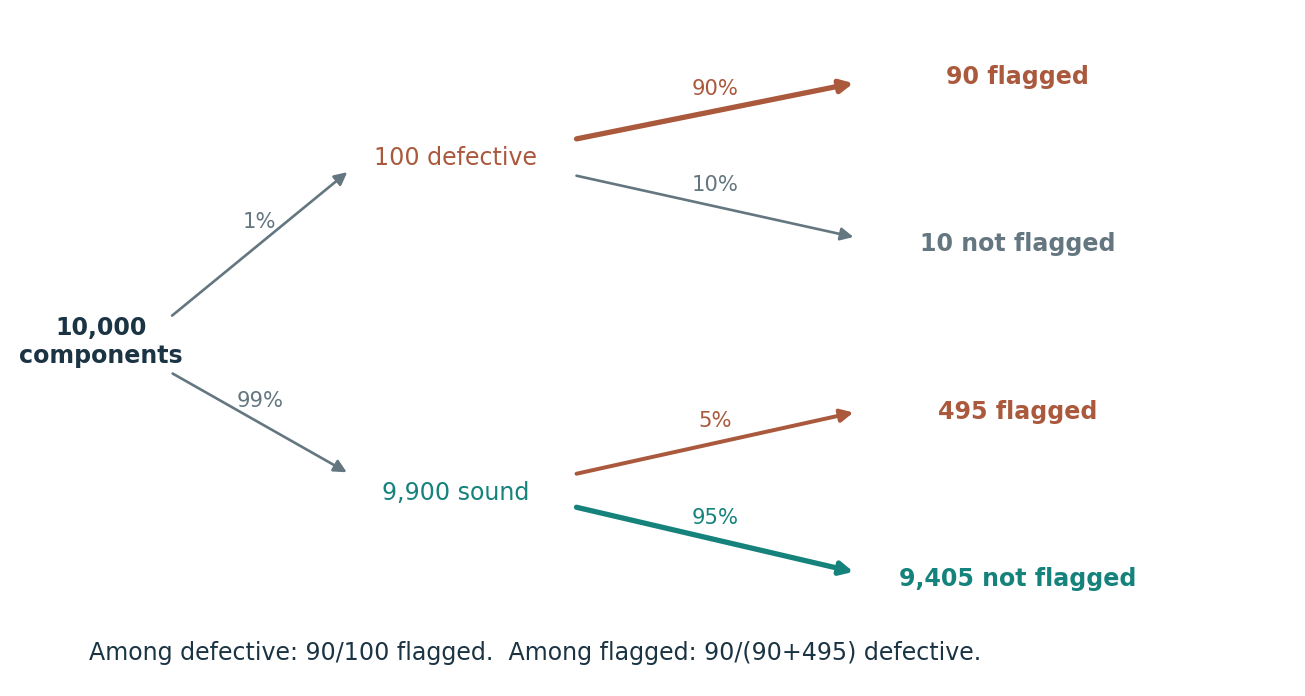
The tree is fixed at the printed chapter values. The table and answer above respond to your inputs.
At least one event
For independent trials with a common event chance, no events has probability (1−p)n. A shared batch shock breaks independence.
1−(1−0.1)10 = 0.6513.
A rate needs a duration
Under a constant-rate Poisson model, zero events in an interval has probability e−rt. Compare a half hour and two hours.
Exposure mean: 1.0 event; P(0) = e−1.
Run the exact checks
Download the standard-library Python lab. It reconstructs the four cells, verifies Bayes' rule, checks a binomial mass sum and enumerates the hypergeometric example.
python3 uncertainty_lab.py
Flagged: 585/10000; defective among flagged: 90/585 = 0.153846
Hypergeometric N=5,K=3,n=2: P(0,1,2) = 1/10, 3/5, 3/10
All exact and numerical checks passed.
Why can a 90% sensitive instrument have only 15.4% true defects among alerts?
It sees a rare defect. A 5% false-alert rate applies to 9,900 sound items, creating 495 false alerts beside 90 true alerts.
When does the binomial shortcut fail?
It needs a fixed number of independent trials with one common success probability. Shared shocks, changing conditions and sampling without replacement can break the model.
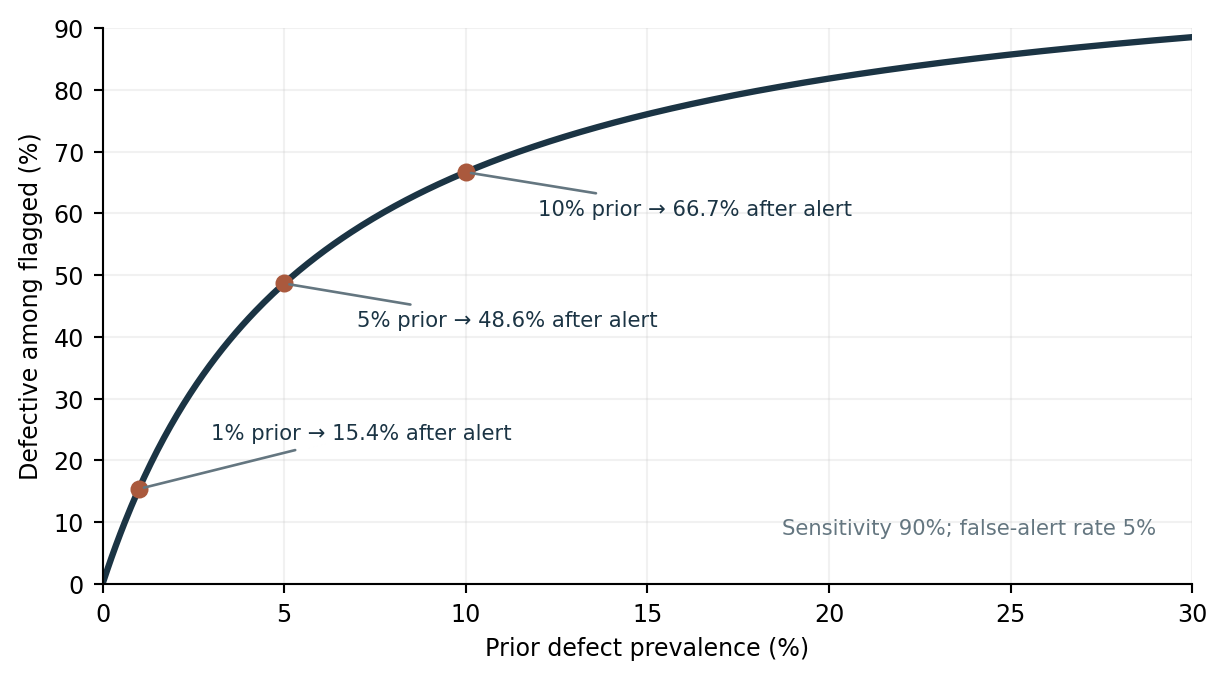
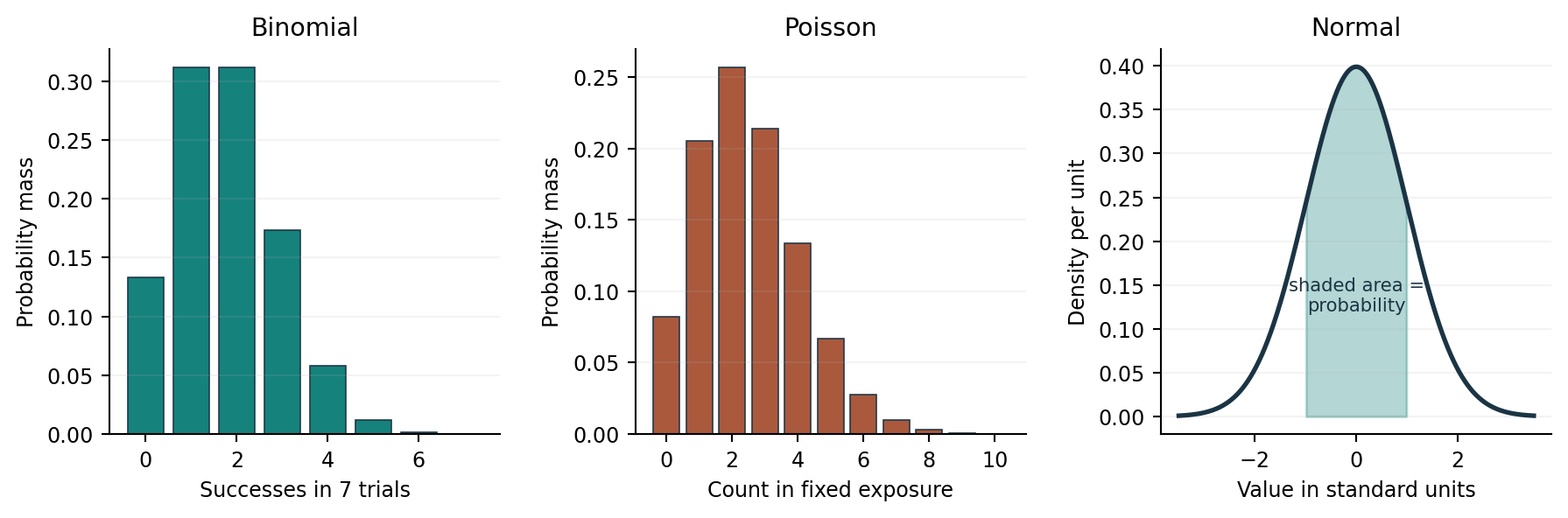
Figures are fixed book illustrations and do not update with controls.
Chapter 5 · private developmental edition. No public QR route has been approved or released.
Inspect the work.
Read the programs, run them in your own environment, and compare the results. The captured output records the chapter’s checked practical run; changing an input may change its answer.
Python uncertainty_lab.py
"""Executed, deterministic companion to Chapter 5. Python standard library only."""
from fractions import Fraction
from math import comb, exp, factorial, isclose

def posterior(prior, sensitivity, false_alert):
    numerator = sensitivity * prior
    denominator = numerator + false_alert * (1 - prior)
    if denominator == 0:
        raise ValueError("The alert event has zero probability under this model")
    return numerator / denominator

cells = {"defect_alert": 90, "defect_no_alert": 10,
         "sound_alert": 495, "sound_no_alert": 9405}
assert sum(cells.values()) == 10000
flagged = cells["defect_alert"] + cells["sound_alert"]
bayes = posterior(.01, .90, .05)
assert isclose(bayes, 90 / 585, abs_tol=1e-15)
print(f"Flagged: {flagged}/10000; defective among flagged: {cells['defect_alert']}/{flagged} = {bayes:.6f}")
print(f"Defective among unflagged: 10/9415 = {10/9415:.6f}")

for prior in (.01, .05, .1):
    print(f"Prior {prior:.0%} -> after alert {posterior(prior,.9,.05):.6f}")

binom = [comb(10,k)*(.1**k)*(.9**(10-k)) for k in range(11)]
assert isclose(sum(binom),1,abs_tol=1e-14)
print(f"Binomial n=10,p=.1: P(X=2)={binom[2]:.6f}; P(X>=1)={1-binom[0]:.6f}")

poisson0 = exp(-1)
poisson2 = exp(-3)*3**2/factorial(2)
print(f"Poisson: zero in 0.5 hour at 2/h = {poisson0:.6f}; two in 2h at 1.5/h = {poisson2:.6f}")

hyper = [Fraction(comb(3,x)*comb(2,2-x),comb(5,2)) for x in range(3)]
assert sum(hyper)==1
assert sum(x*hyper[x] for x in range(3))==Fraction(6,5)
print(f"Hypergeometric N=5,K=3,n=2: P(0,1,2) = {', '.join(map(str,hyper))}")
print("Common shock: P(both defects)=0.1, independent shortcut=0.01")
print("All exact and numerical checks passed.")
Output Checked chapter run
Flagged: 585/10000; defective among flagged: 90/585 = 0.153846
Defective among unflagged: 10/9415 = 0.001062
Prior 1% -> after alert 0.153846
Prior 5% -> after alert 0.486486
Prior 10% -> after alert 0.666667
Binomial n=10,p=.1: P(X=2)=0.193710; P(X>=1)=0.651322
Poisson: zero in 0.5 hour at 2/h = 0.367879; two in 2h at 1.5/h = 0.224042
Hypergeometric N=5,K=3,n=2: P(0,1,2) = 1/10, 3/5, 3/10
Common shock: P(both defects)=0.1, independent shortcut=0.01
All exact and numerical checks passed.