The ruler and the world
A sensor can be precise and still answer the wrong question. First check the ruler; then ask what world it was meant to measure.
Local developmental companion. Six synthetic readings; no real classroom data. The calculation remains on this device.
In this chapter
What does 28 °C mean?
The reference chamber and a constructed sensor give three paired means. Move the observed sensor reading. The correction uses the fitted line only within the measured 20–30 °C reference range.
Reference estimate = (observed reading + 0.7) / 1.06
Within the calibrated reference range under the constructed line.
How the line was made
| Reference | Mean reading | Error |
|---|---|---|
| 20 °C | 20.5 °C | +0.5 °C |
| 25 °C | 25.8 °C | +0.8 °C |
| 30 °C | 31.1 °C | +1.1 °C |
The mean error grows with temperature. Subtracting one fixed offset would correct only one point. This exact linear pattern was constructed for teaching; real calibration requires a design and an uncertainty budget.
A line and its domain
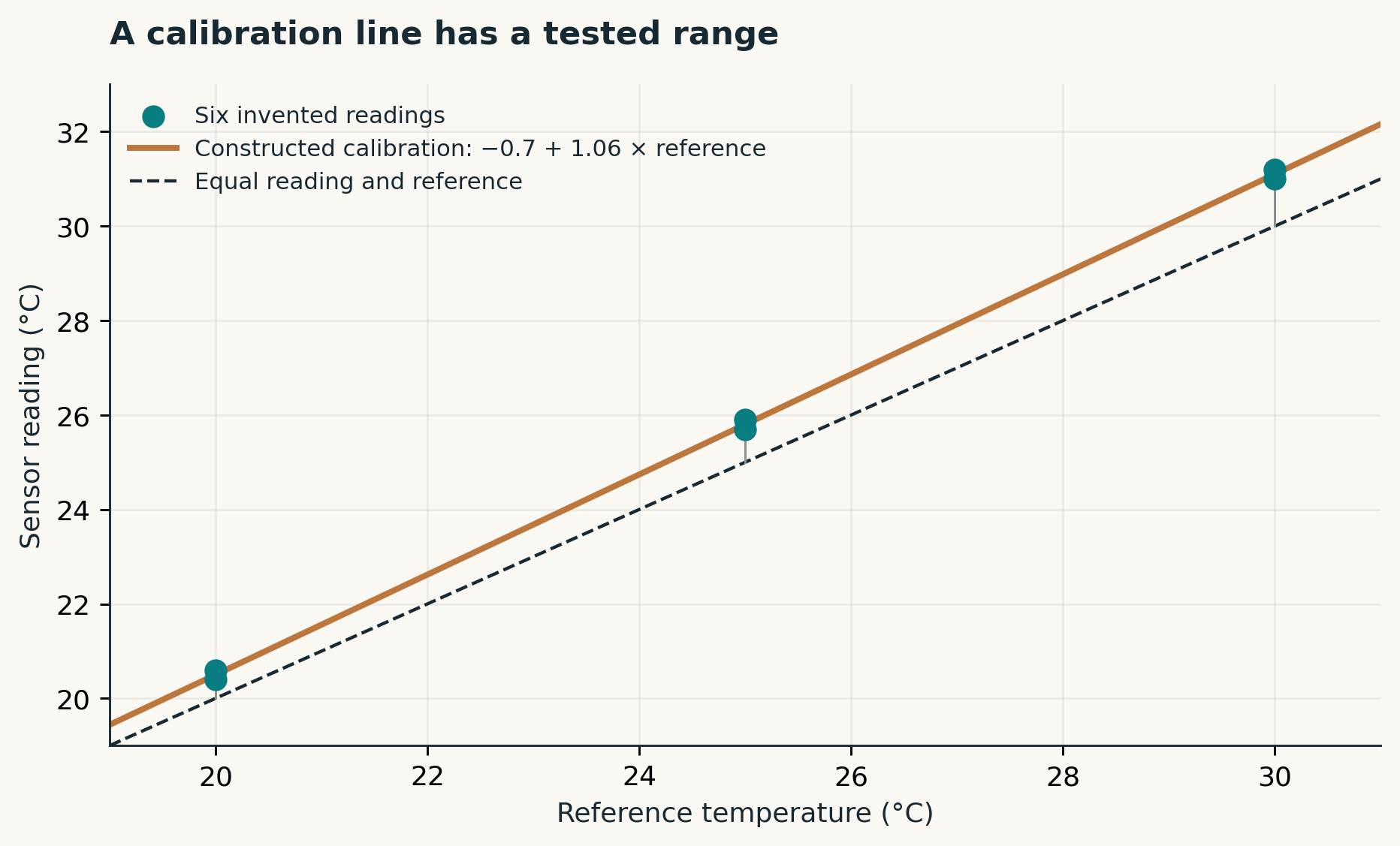
The line cannot check drift after a month, placement beside a warm wall, or whether air temperature represents comfort for occupied desks.
Challenge the measurement
- Derive slope and intercept from the endpoint means. Check the middle mean without refitting.
- Add a later-session drift of +0.3 °C. What new reference observation would reveal it?
- Change one row’s unit label to Fahrenheit without converting its numeric value. Write a validation rule that rejects the mixed units.
- Explain why a 0.224 °C repeatability standard deviation is not the whole uncertainty of a classroom estimate.
Run and inspect
Synthetic CSV · Executed Python practical · Executed base-R practical · Captured R output · Worked solutions
Run from this folder. Both programs assert the line and corrected reading before reporting success. R preserves the CSV’s reserved-word repeat header with check.names=FALSE.
Calibration: reading = -0.7 + 1.06 × reference
Corrected 28.0 °C reading: 27.075 °C
Five-reading sample SD: 0.224 °C
Program outputs are from constructed fixtures. They do not validate a real sensor or an indoor-health decision.
Inspect the work.
Read the programs, run them in your own environment, and compare the results. The captured output records the chapter’s checked practical run; changing an input may change its answer.
Python calibration.py
"""Synthetic Chapter 3 calibration; standard-library Python 3."""
from collections import defaultdict
import csv
from pathlib import Path
from statistics import mean, stdev

path = Path(__file__).with_name("calibration.csv")
groups = defaultdict(list)
with path.open(newline="", encoding="utf-8") as handle:
    for row in csv.DictReader(handle):
        groups[float(row["reference_c"])].append(float(row["reading_c"]))
means = {reference: mean(values) for reference, values in sorted(groups.items())}
for reference, value in means.items():
    print(f"Reference {reference:.1f} °C: mean {value:.1f} °C, error {value-reference:+.1f} °C")
refs = sorted(means)
slope = (means[refs[-1]] - means[refs[0]]) / (refs[-1] - refs[0])
intercept = means[refs[0]] - slope * refs[0]
assert all(abs(means[reference] - (intercept + slope * reference)) < 1e-12 for reference in refs)
corrected = (28.0 - intercept) / slope
print(f"Calibration: reading = {intercept:.1f} + {slope:.2f} × reference")
print(f"Corrected 28.0 °C reading: {corrected:.3f} °C")
repeat_reads = [20.2, 20.4, 20.5, 20.6, 20.8]
print(f"Five-reading mean: {mean(repeat_reads):.1f} °C")
print(f"Five-reading sample SD: {stdev(repeat_reads):.3f} °C")
assert abs(corrected - 28.7 / 1.06) < 1e-12
assert abs(stdev(repeat_reads) - 0.05 ** .5) < 1e-12
R calibration.R
# Constructed Chapter 2 calibration. Base R; run from this directory.
d <- read.csv('calibration.csv', stringsAsFactors = FALSE, check.names = FALSE)
stopifnot(identical(names(d), c('reference_c','reading_c','repeat')))
stopifnot(nrow(d)==6L, all(is.finite(d$reference_c)), all(is.finite(d$reading_c)))
m <- aggregate(reading_c ~ reference_c, data=d, FUN=mean)
m <- m[order(m$reference_c),]
stopifnot(isTRUE(all.equal(m$reading_c,c(20.5,25.8,31.1))))
slope <- (m$reading_c[3]-m$reading_c[1])/(m$reference_c[3]-m$reference_c[1])
intercept <- m$reading_c[1]-slope*m$reference_c[1]
corrected <- (28-intercept)/slope
repeat_reads <- c(20.2,20.4,20.5,20.6,20.8)
repeat_sd <- sd(repeat_reads)
stopifnot(isTRUE(all.equal(slope,1.06)),isTRUE(all.equal(intercept,-0.7)))
stopifnot(isTRUE(all.equal(corrected,28.7/1.06)))
stopifnot(isTRUE(all.equal(repeat_sd,sqrt(.05))))
cat(sprintf('CALIBRATION reading = %.1f + %.2f * reference\n',intercept,slope))
cat(sprintf('CORRECTED 28.0 C READING %.3f C\n',corrected))
cat(sprintf('FIVE-READING SAMPLE SD %.3f C\n',repeat_sd))
cat('BASE-R CALIBRATION CHECKS PASS\n')
Output Checked chapter run
Reference 20.0 °C: mean 20.5 °C, error +0.5 °C
Reference 25.0 °C: mean 25.8 °C, error +0.8 °C
Reference 30.0 °C: mean 31.1 °C, error +1.1 °C
Calibration: reading = -0.7 + 1.06 × reference
Corrected 28.0 °C reading: 27.075 °C
Five-reading mean: 20.5 °C
Five-reading sample SD: 0.224 °C