The first ledger
Four rooms, one ledger, two answers. Change the occupied seat-hours and watch the question alter the answer—even when each room’s hot fraction stays fixed.
Synthetic teaching data. The 20% inspection line in the chapter is an illustrative policy choice. These records do not diagnose a ventilation fault.
Try the investigation
For each room, the hot fraction stays fixed. Edit only its occupied seat-hours. Tick a room off to change the observed population.
| Include | Room | Hot fraction | Seat-hours |
|---|
Write down what each answer represents. Which one answers “What fraction of recorded occupied student-seat-hours were hot?”
Three evidence moves
- Define: identify the population, unit, time window, outcome and decision before calculating.
- Challenge: remove room D. Explain why the estimated seat-hour rate changes.
- Transfer: write an analysis contract for a clinic queue, bus route or farm sensor. Name an absent event that could alter the denominator.
What the figure asks
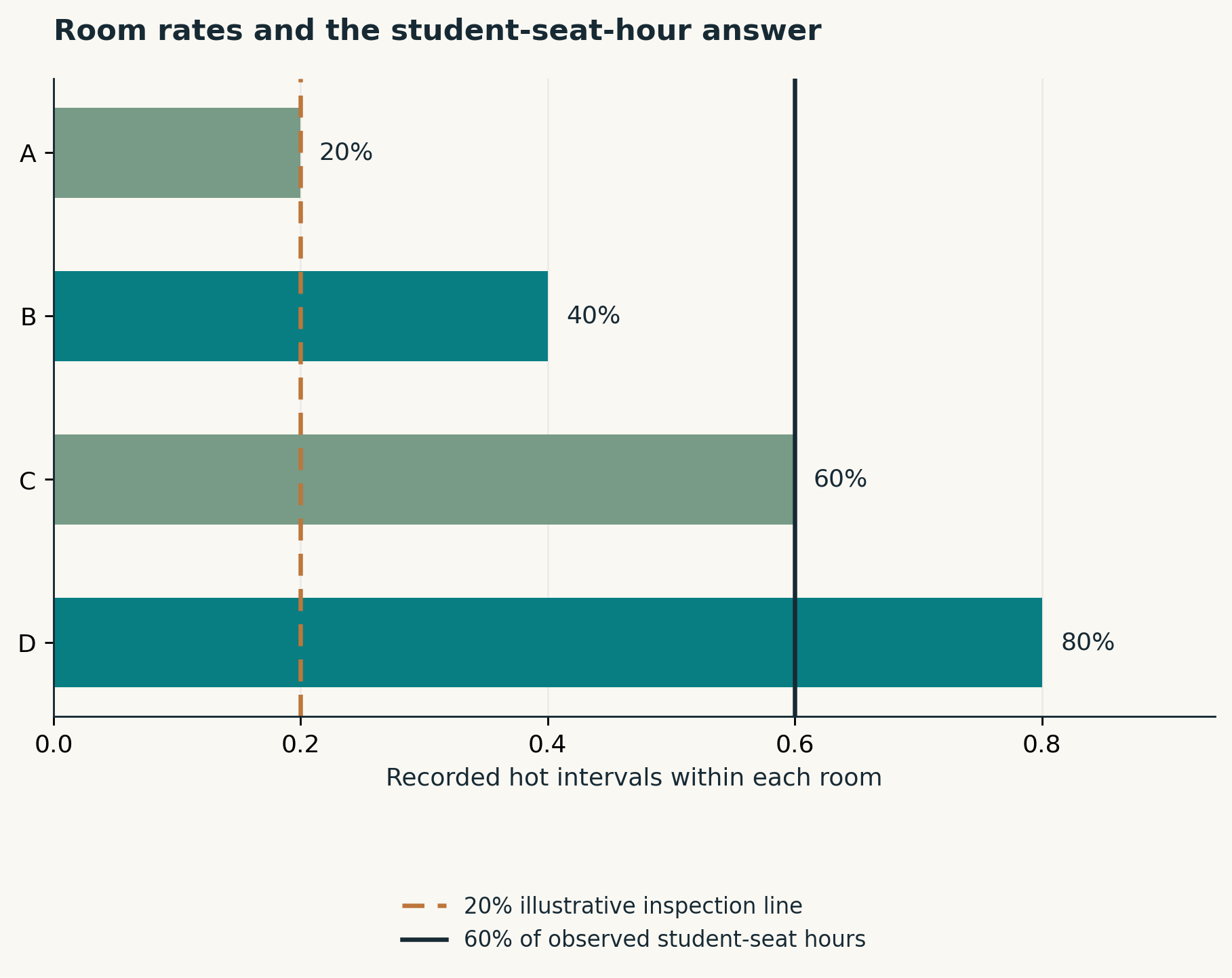
Why does the seat-hour answer differ from the mean of four room rates? The plotted line is an observed ratio in this invented dataset, not a probability of a faulty system.
Inspect the work.
Read the programs, run them in your own environment, and compare the results. The captured output records the chapter’s checked practical run; changing an input may change its answer.
Python investigation.py
"""Chapter 2: synthetic classroom estimands; run with Python 3."""
import csv
from pathlib import Path

DATA = Path(__file__).with_name("classrooms.csv")


def read_rooms(path=DATA):
    with path.open(newline="", encoding="utf-8") as handle:
        rows = list(csv.DictReader(handle))
    assert rows and len({row["room"] for row in rows}) == len(rows)
    for row in rows:
        for key in ("hot_intervals", "intervals", "hot_seat_hours", "seat_hours"):
            row[key] = int(row[key])
        assert 0 <= row["hot_intervals"] <= row["intervals"]
        assert 0 <= row["hot_seat_hours"] <= row["seat_hours"]
    return rows


def describe(rows):
    room_mean = sum(row["hot_intervals"] / row["intervals"] for row in rows) / len(rows)
    seat_rate = sum(row["hot_seat_hours"] for row in rows) / sum(row["seat_hours"] for row in rows)
    return room_mean, seat_rate


def main():
    rows = read_rooms()
    room_mean, seat_rate = describe(rows)
    print(f"Room mean: {room_mean:.1%}")
    print(f"Student-seat-hour rate: {seat_rate:.1%}")
    without_d = [row for row in rows if row["room"] != "D"]
    mean_without_d, seat_without_d = describe(without_d)
    print(f"Without D — room mean: {mean_without_d:.1%}; seat-hour rate: {seat_without_d:.1%}")
    doubled_a = [dict(row) for row in without_d]
    doubled_a[0]["hot_seat_hours"] *= 2
    doubled_a[0]["seat_hours"] *= 2
    print(f"Without D, A doubled — seat-hour rate: {describe(doubled_a)[1]:.1%}")
    assert (room_mean, seat_rate) == (0.5, 0.6)
    assert abs(seat_without_d - 280 / 600) < 1e-12
    assert abs(describe(doubled_a)[1] - 300 / 700) < 1e-12


if __name__ == "__main__":
    main()
Output Checked chapter run
Room mean: 50.0%
Student-seat-hour rate: 60.0%
Without D — room mean: 40.0%; seat-hour rate: 46.7%
Without D, A doubled — seat-hour rate: 42.9%