InnoWorks Press
INNOWORKS PRESS · REVIEW EDITION
Science and mathematics
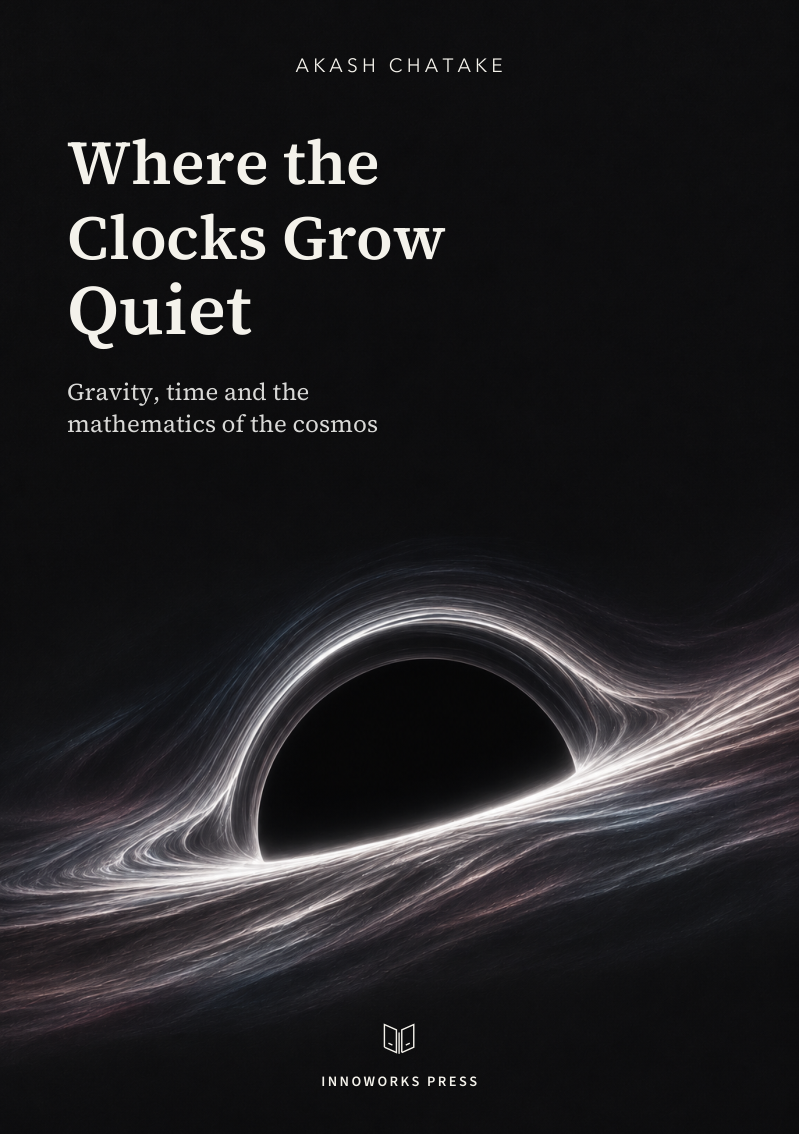
Where the Clocks Grow Quiet
Gravity, time and the mathematics of the cosmos
A falling stone opens a question that eventually reaches the edge of a black hole. This short science manuscript moves through motion, calculus, gravity, relativity and the expanding universe, pausing to explain how a difficult idea becomes something we can reason with. A mathematical walking trail and exercises offer ways to examine the narrative rather than merely admire it. Historical accounts are treated as accounts to understand; speculative possibilities remain distinct from established observations. The intended experience is a quiet journey through questions that grow larger as familiar answers become more precise.
Manuscript and companion under editorial and technical review. This local preview does not announce publication or sale.
Inside the book
A route through the ideas
Who it is for
Curious general readers with arithmetic, patience and an interest in science; the mathematical trail offers optional deeper study.
- The falling sky
- The arithmetic of a moment
- The equation that predicts a journey
- The clock with a longer road
- The weight of an hour
- The border without a wall
- Learning to see the dark
- A bridge drawn in equations
- The room that grows between galaxies
- The unfinished map
Chapter titles follow the current review manuscript. Final pagination and edition details remain subject to review.
From the opening chapter
Begin with an idea
A stone falls toward Earth. The Moon does not appear to fall at all. This difference once helped divide the universe into two jurisdictions: the changeable world below and the ordered heavens above. Aristotle's natural philosophy distinguished terrestrial change from celestial motion. Much later, Galileo investigated falling and accelerated motion, while Kepler described planetary orbits using astronomical observations. Their work did not constitute one modern theory, and their lives were not consecutive chapters with perfectly clean handovers. Newtonian mechanics eventually made the division between earthly and heavenly mechanics unnecessary. An orbiting body is falling, but it also moves sideways. Its path can keep bending around Earth without meeting the ground.
Imagine launching a ball horizontally above an ideal Earth without atmosphere. At low speed it reaches the surface. At sufficient speed the surface curves away beneath its trajectory. For a circular orbit, gravity supplies exactly the inward acceleration needed to bend the motion. The ball has not escaped gravity. Gravity is doing all the work of turning its direction, although, in this ideal circular case, it does no work in the energy-transfer sense because force and velocity are perpendicular.
Here is our first useful distinction. Speed tells us how rapidly distance is covered. Velocity adds direction. A body moving around a circle at constant speed still accelerates because its velocity keeps changing direction. Acceleration is not necessarily a dramatic shove into a seat. It is a change in velocity, including a change in where that velocity points.
Beyond the page
Make the idea work
Read. Predict. Experiment. Explain.
Follow a thought experiment into a small calculation. Change a condition, compare outcomes and keep the distinction between a model and the world it describes.
- Read the argument before running the calculation.
- Change an input or assumption and inspect the result.
- Explain what the model supports, and what it leaves open.
Chapter QR codes connect the print proof to these materials. The online edition is being prepared locally; public links require a verified release.
The book as an object
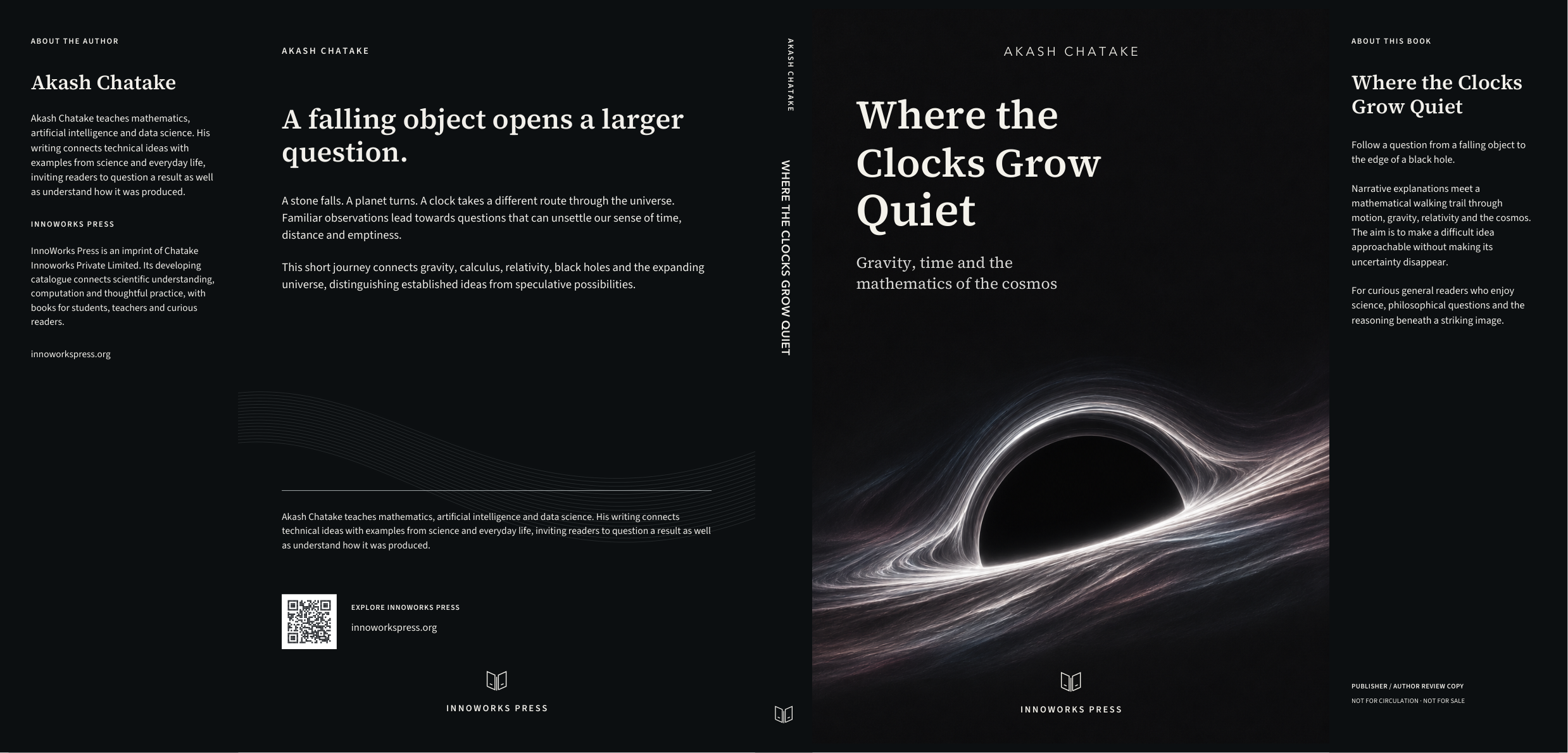
Cover and jacket
Selected artwork · design proofs