InnoWorks Press
INNOWORKS PRESS · REVIEW EDITION
Science and mathematics
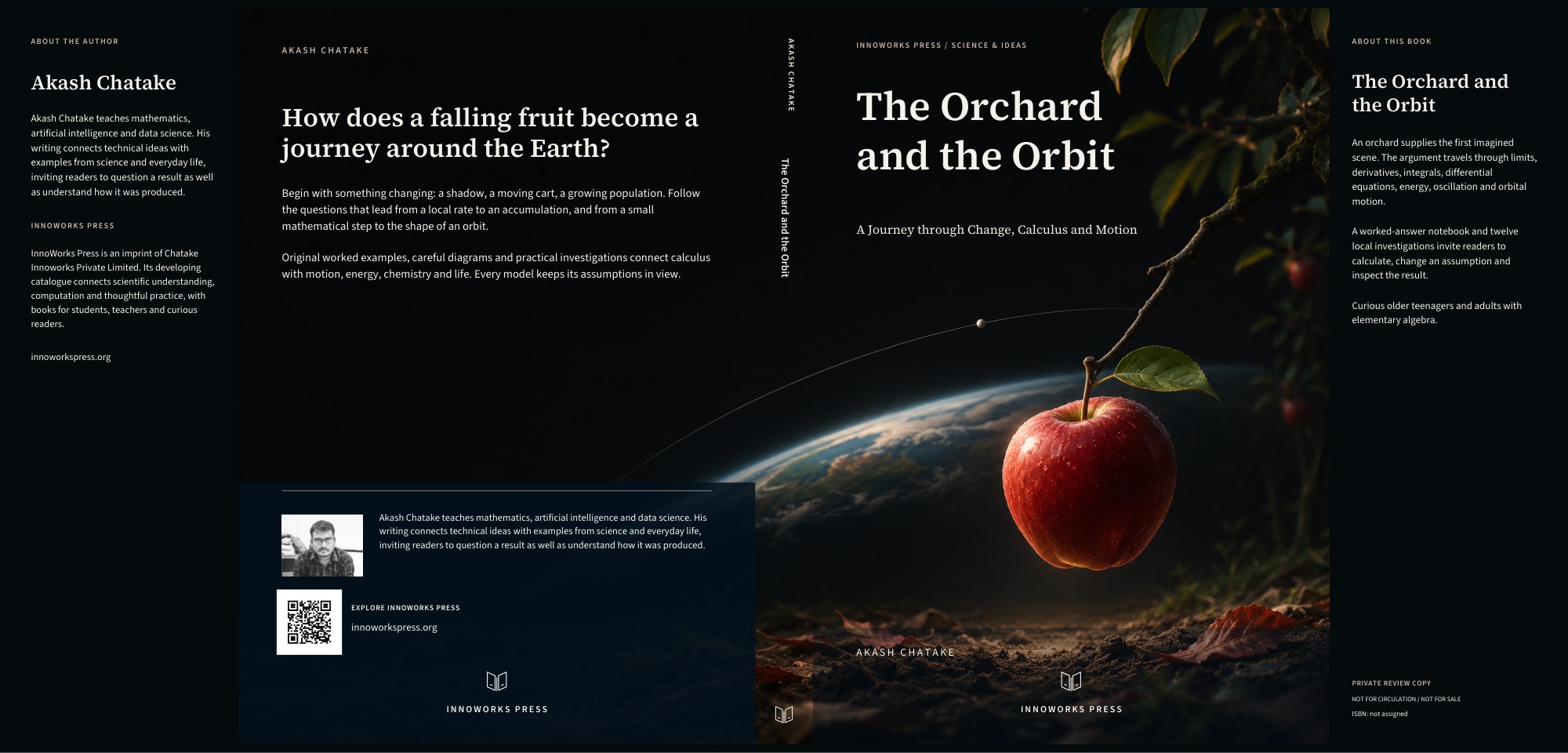
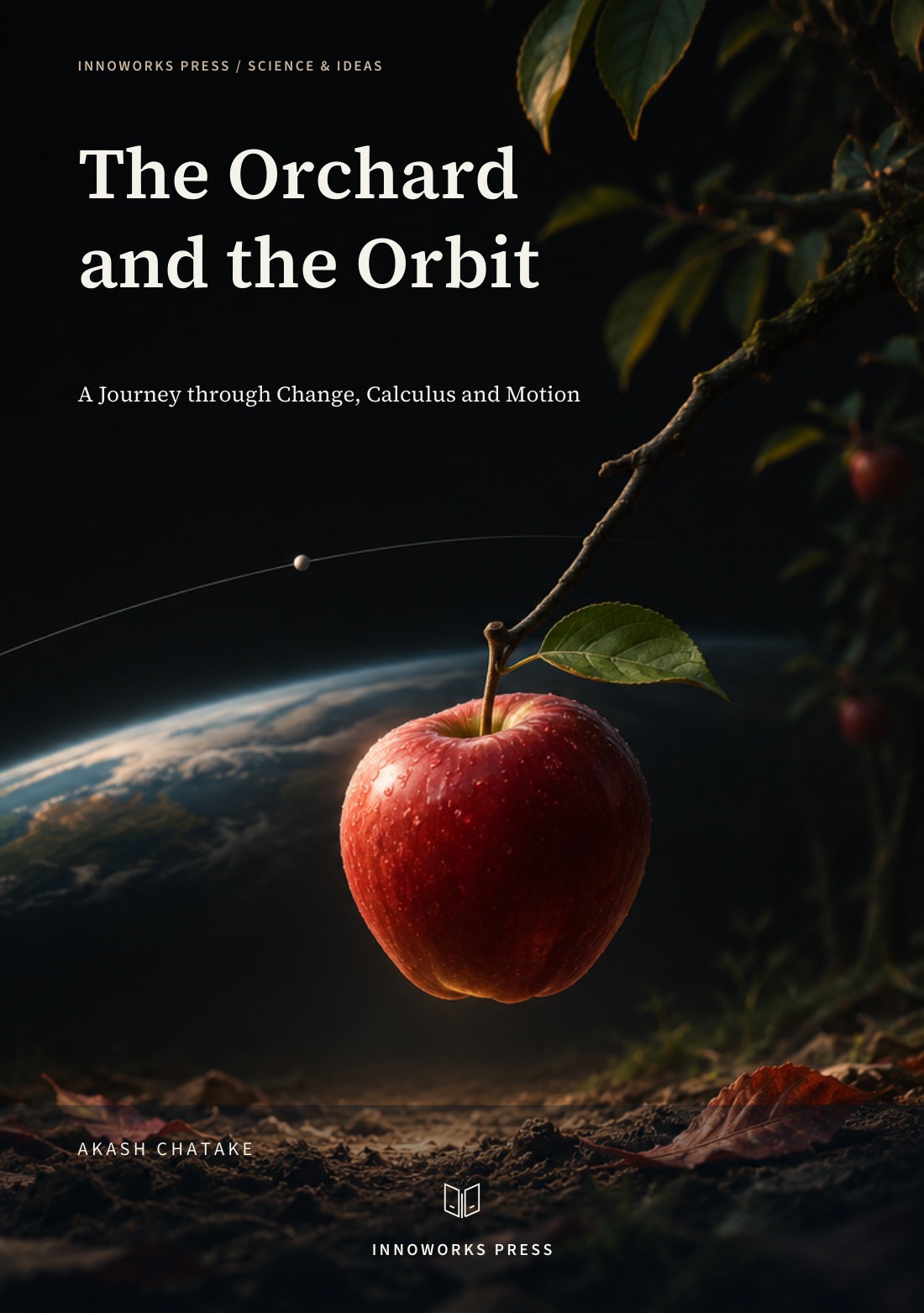
The Orchard and the Orbit
A Journey through Change, Calculus and Motion
Begin with something changing: a shadow, a moving cart, a growing population. Follow the questions that lead from a local rate to an accumulation, and from a small mathematical step to the shape of an orbit. Original worked examples, careful diagrams and practical investigations connect calculus with motion, energy, chemistry and life. Every model keeps its assumptions in view.
Manuscript and companion under editorial and technical review. This local preview does not announce publication or sale.
Inside the book
A route through the ideas
Who it is for
Curious older teenagers and adults with elementary algebra.
- The fruit and the clock
- Near enough to an instant
- The grammar of a small change
- The shape of a journey
- The patience of small pieces
- The bridge between rate and total
- A rule that makes a history
- The accounts of motion
- The art of returning
- Falling with room to miss
- What the measurement left out
- An observatory on a table
Chapter titles follow the current review manuscript. Final pagination and edition details remain subject to review.
From the opening chapter
Begin with an idea
An orchard is not a laboratory until somebody asks a question that can be answered there. Before that, it is shade, uneven ground, insects, weather and fruit. A falling object does not arrive carrying a graph of its journey. Someone must decide where to measure from, when to start a clock and which part of the scene the graph is supposed to describe.
Imagine a small fruit leaving a branch. This is our invented starting scene, not a reconstruction of an episode in Newton's life. We shall return to the orchard because it contains a surprisingly large part of mechanics: positions, changing speeds, resistance, energy and the difficulty of turning observation into a trustworthy number. Eventually, the same mathematical questions will help describe an orbit. The connection will have to be earned. An apple and a planet do not become equivalent because a sentence places them together.
The first useful act is almost embarrassingly modest. Choose a direction. Let downward displacement from the release point be positive, and call it $y$. Set the release event to $t=0$. A positive $y$ then means farther below the branch. A negative velocity would mean motion upward. These conventions do not instruct nature; they organise our account of it.
Beyond the page
Make the idea work
Read. Predict. Experiment. Explain.
Follow a thought experiment into a small calculation. Change a condition, compare outcomes and keep the distinction between a model and the world it describes.
- Read the argument before running the calculation.
- Change an input or assumption and inspect the result.
- Explain what the model supports, and what it leaves open.
Chapter QR codes connect the print proof to these materials. The online edition is being prepared locally; public links require a verified release.
The book as an object
Cover and jacket
Selected artwork · design proofs