InnoWorks Press
INNOWORKS PRESS · REVIEW EDITION
Science and mathematics
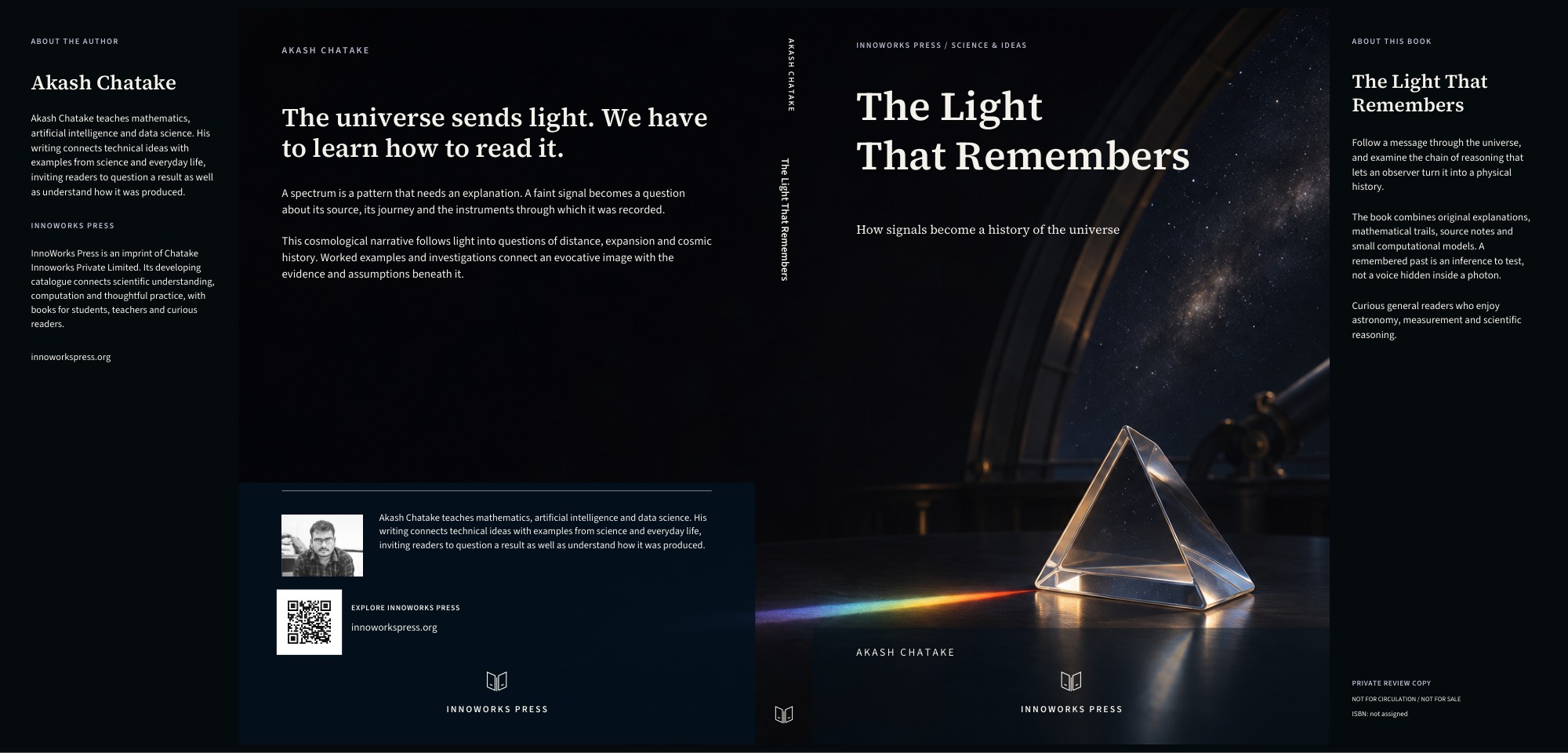
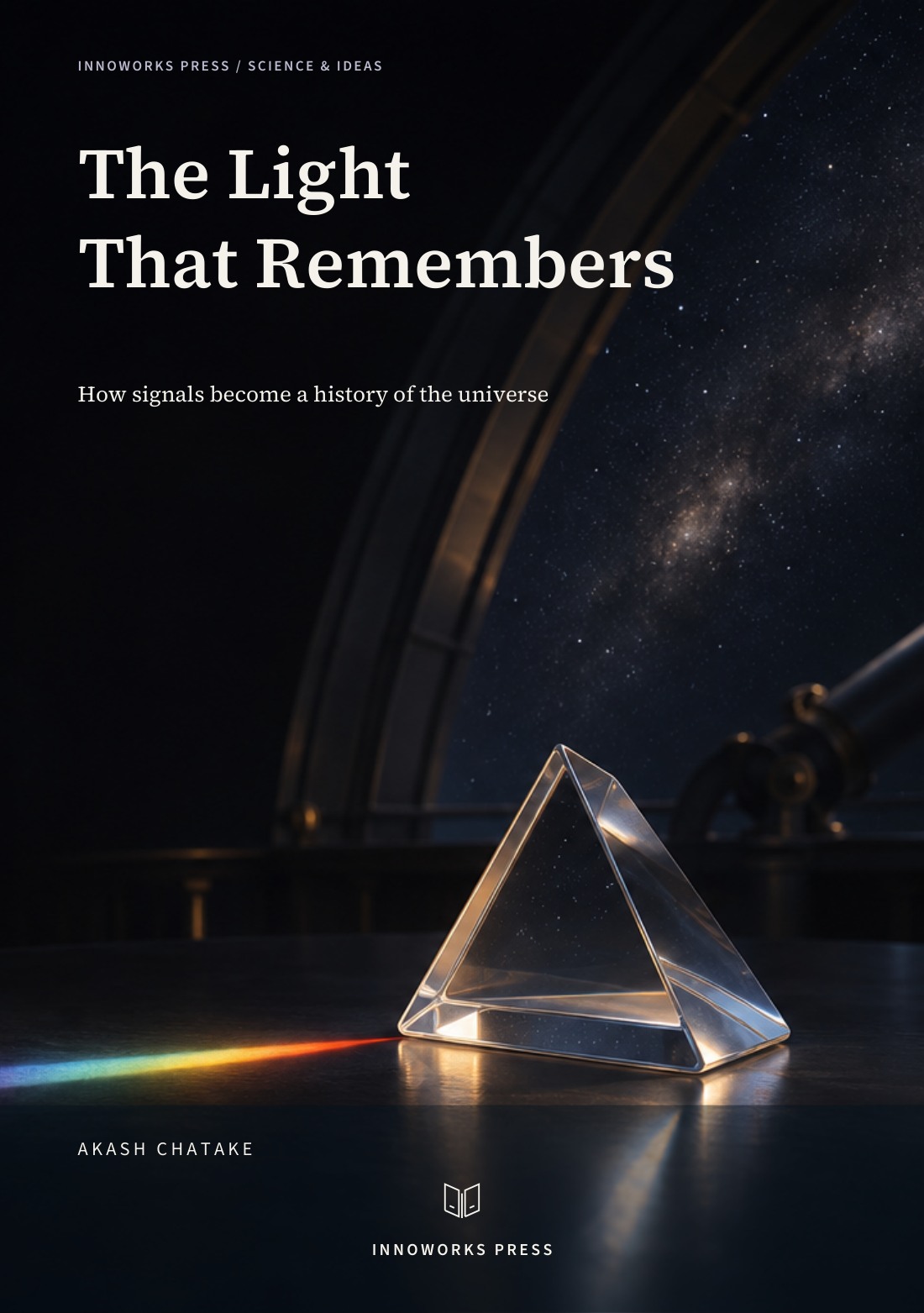
The Light That Remembers
How signals become a history of the universe
A spectrum is a pattern that needs an explanation. A faint signal becomes a question about its source, its journey and the instruments through which it was recorded. This cosmological narrative follows light into questions of distance, expansion and cosmic history. Worked examples and investigations connect an evocative image with the evidence and assumptions beneath it.
Manuscript and companion under editorial and technical review. This local preview does not announce publication or sale.
Inside the book
A route through the ideas
Who it is for
Curious general readers who enjoy astronomy, measurement and scientific reasoning.
- A message without a sentence
- The notches in the rainbow
- The distance we build
- The universe between the marks
- The sky that cooled
- The ruler in the afterglow
- The weight of what we do not see
- The distant explosion and the expanding account
- Three distances and a horizon
- The universe we infer
Chapter titles follow the current review manuscript. Final pagination and edition details remain subject to review.
From the opening chapter
Begin with an idea
Near dawn, an observer looks at a narrow band of colour on a screen. It is not the spectacular image she had hoped to show a visitor. There are no spiral arms, no luminous clouds, no bright planet with a recognisable edge. There are numbers, calibration marks, a few dark notches, and the possibility that one of those notches has arrived from a place whose present condition she cannot yet see.
The observer is fictional. The kind of work is real. Astronomy often becomes most powerful when the beautiful picture is separated into measurements that look less immediately beautiful. Wavelength, flux, direction, polarisation, time, and uncertainty carry information that a single glance cannot organise. The task is to turn those measurements into a physical account without asking them to say more than they can.
The light in this book remembers only metaphorically. It has no diary and no intention to tell us a story. Its properties have been shaped by emission, propagation, interactions, and detection. Under a physical model, those properties can constrain past conditions. A photon is not a little historian. Yet a carefully measured field can become evidence of events far outside our direct reach.
Beyond the page
Make the idea work
Read. Predict. Experiment. Explain.
Follow a thought experiment into a small calculation. Change a condition, compare outcomes and keep the distinction between a model and the world it describes.
- Read the argument before running the calculation.
- Change an input or assumption and inspect the result.
- Explain what the model supports, and what it leaves open.
Chapter QR codes connect the print proof to these materials. The online edition is being prepared locally; public links require a verified release.
The book as an object
Cover and jacket
Selected artwork · design proofs