InnoWorks Press
INNOWORKS PRESS · REVIEW EDITION
Science and mathematics
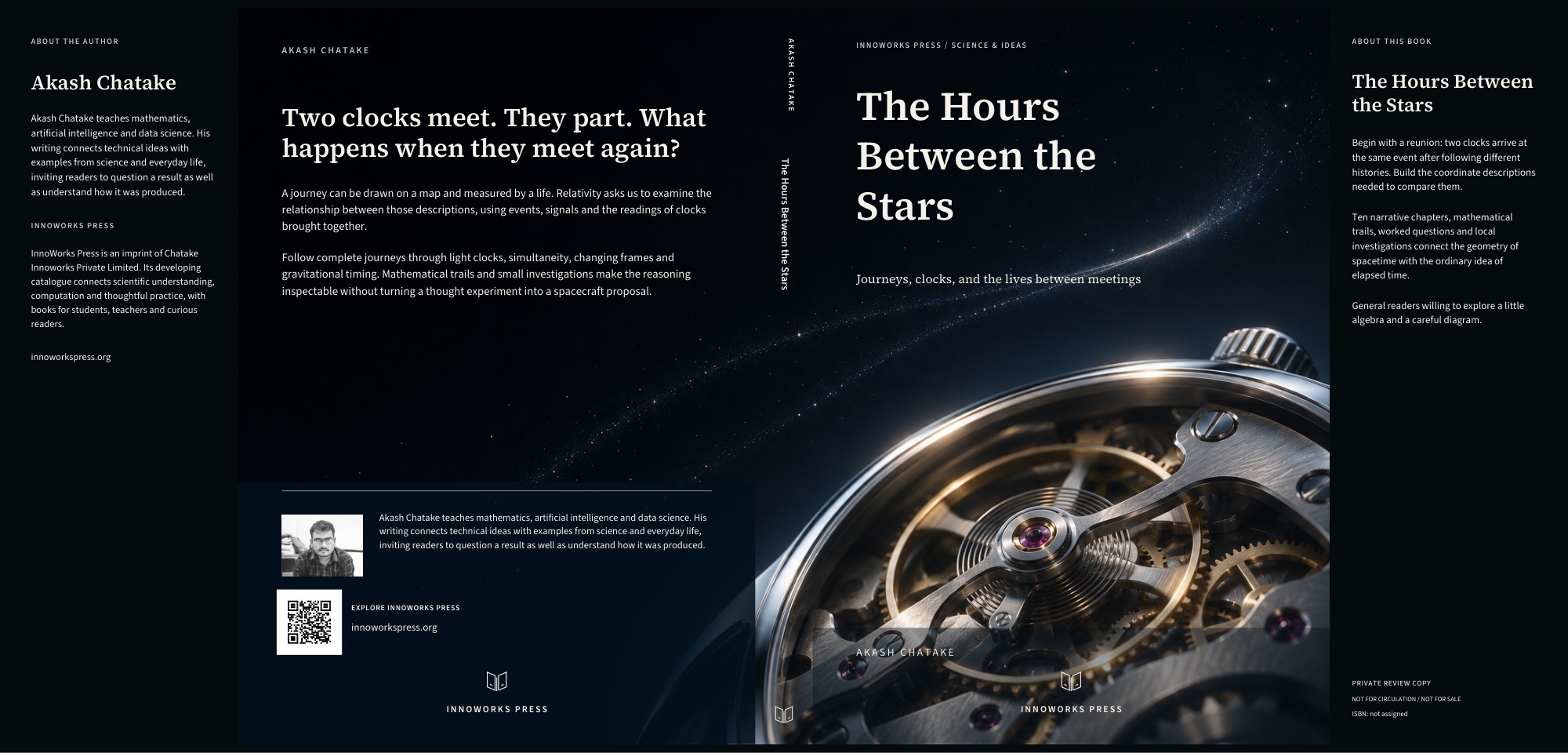
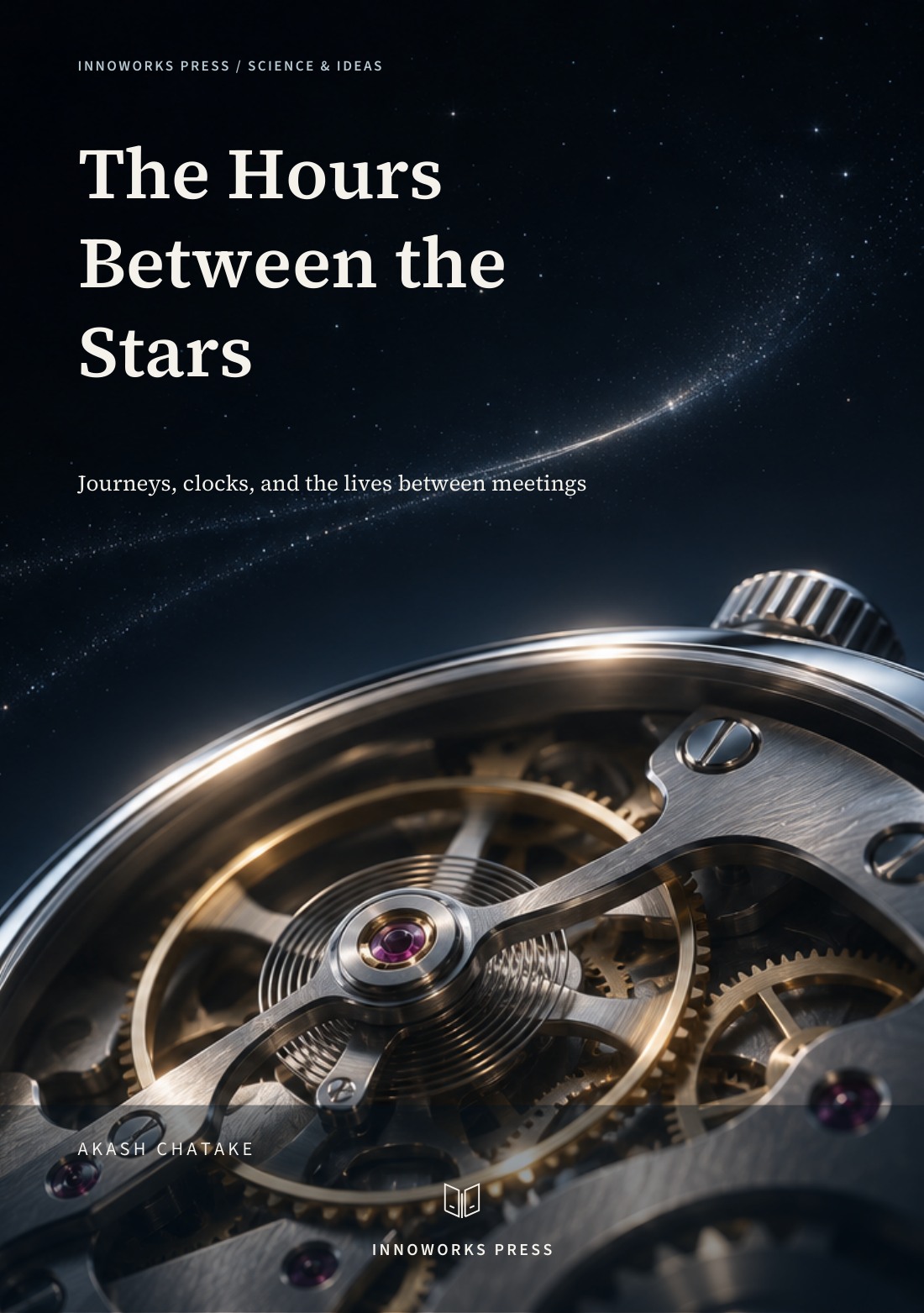
The Hours Between the Stars
Journeys, clocks, and the lives between meetings
A journey can be drawn on a map and measured by a life. Relativity asks us to examine the relationship between those descriptions, using events, signals and the readings of clocks brought together. Follow complete journeys through light clocks, simultaneity, changing frames and gravitational timing. Mathematical trails and small investigations make the reasoning inspectable without turning a thought experiment into a spacecraft proposal.
Manuscript and companion under editorial and technical review. This local preview does not announce publication or sale.
Inside the book
A route through the ideas
Who it is for
General readers willing to explore a little algebra and a careful diagram.
- Where the clocks meet
- How a city agrees on now
- The shape of a possible message
- The returning clock
- The messages on the way home
- A turn is a history
- The clock on the shelf
- A satellite keeps two accounts
- How a second becomes evidence
- The future a journey can reach
Chapter titles follow the current review manuscript. Final pagination and edition details remain subject to review.
From the opening chapter
Begin with an idea
A railway platform is a good place to begin a book about time because almost everyone there is already conducting an experiment. Someone glances at a watch, then at the departure board. Someone else receives a message saying that the train has left. These are not three interchangeable encounters with the present. A watch reports a local reading. A departure board displays information supplied by a system. A message connects its reader to an event that happened elsewhere and earlier. Daily life works because the distinctions are usually small enough, and the institutions reliable enough, that we can move between them without a seminar.
Relativity begins when we stop letting the distinctions pass unnoticed. It does not begin by announcing that nothing is real or that every opinion has its own clock. A train either passes a particular marker or it does not. Two clocks either meet or remain apart. A pulse either arrives at a detector or it does not. The theory asks how observers relate those events to measurements of space and time. Its strangeness becomes more manageable when we give the familiar words a precise job.
Consider an imaginary pair of clocks carried by two people. We shall call the people Asha and Robin, not because the mathematics needs characters but because keeping their journeys distinct will matter. They meet at a platform pillar, compare their clocks and set both readings to zero. Later they separate, follow different routes and meet again. At the second meeting, the clocks are together. Nobody needs to decide what a distant clock is doing right now. The two displays can be placed side by side.
Beyond the page
Make the idea work
Read. Predict. Experiment. Explain.
Follow a thought experiment into a small calculation. Change a condition, compare outcomes and keep the distinction between a model and the world it describes.
- Read the argument before running the calculation.
- Change an input or assumption and inspect the result.
- Explain what the model supports, and what it leaves open.
Chapter QR codes connect the print proof to these materials. The online edition is being prepared locally; public links require a verified release.
The book as an object
Cover and jacket
Selected artwork · design proofs