InnoWorks Press
INNOWORKS PRESS · REVIEW EDITION
Science and mathematics
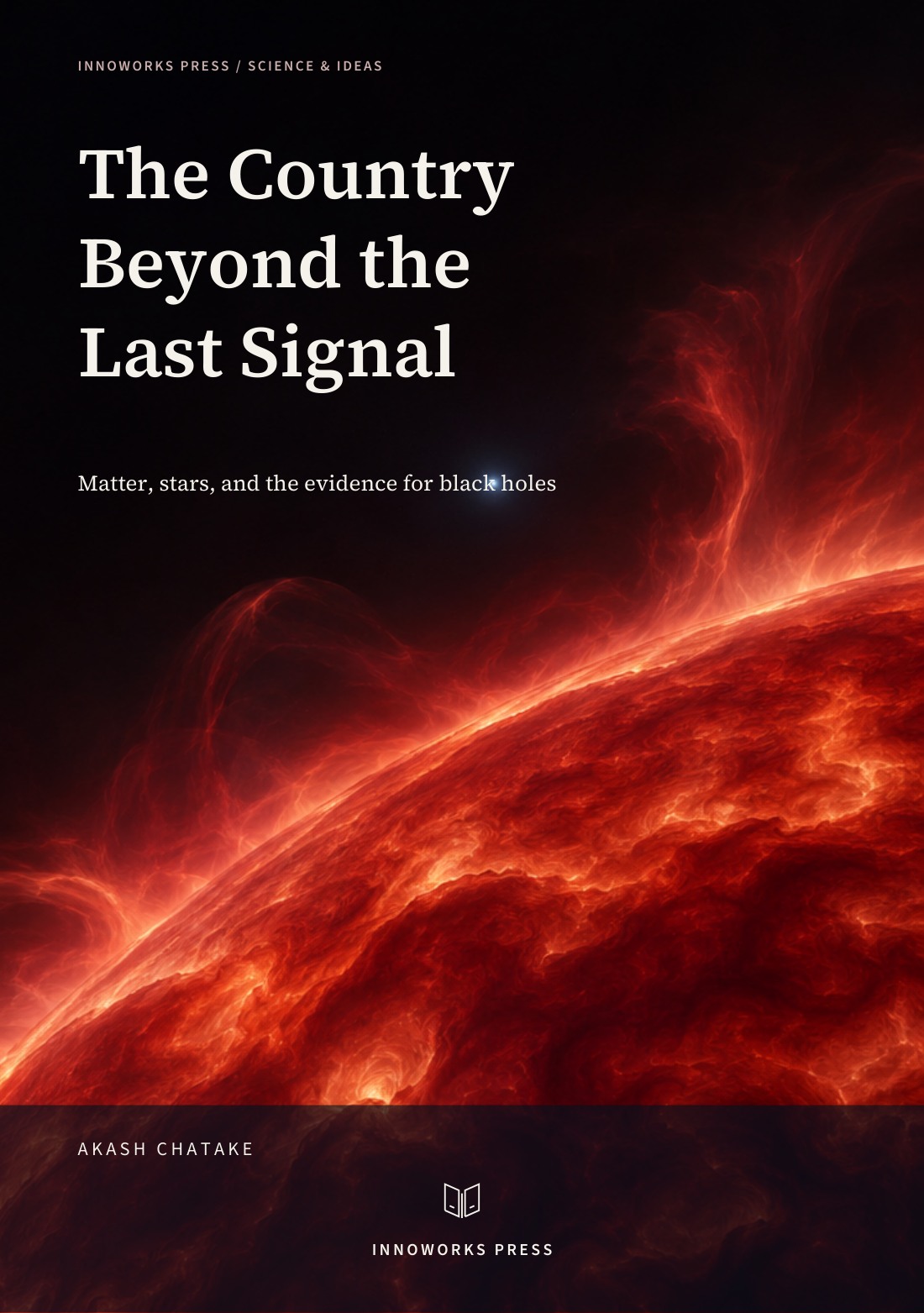
The Country Beyond the Last Signal
Matter, stars, and the evidence for black holes
A star has a history written in matter, pressure, temperature and escaping light. To read it, we must connect a physical model with the observations that can reach us. This journey follows stellar lives towards compact remnants, black holes and observational horizons. It asks what a signal establishes, which assumptions support the inference, and where an honest answer must remain incomplete.
Manuscript and companion under editorial and technical review. This local preview does not announce publication or sale.
Inside the book
A route through the ideas
Who it is for
Curious readers of astronomy and the physical sciences.
- A handful of darkness
- The cloud that learns to shine
- The long balance
- When the centre changes
- The room inside matter
- The core that cannot wait
- The last outward road
- Light around an absence
- The orbit and the chirp
- What the darkness keeps
Chapter titles follow the current review manuscript. Final pagination and edition details remain subject to review.
From the opening chapter
Begin with an idea
At the edge of a city, a child holds a dark stone beneath a streetlight. Turn it one way and a narrow surface gleams. Turn it another and the shine disappears. The stone has not disappeared. Something about the route between lamp, stone, and eye has changed. This small distinction is our first instrument for thinking about a black hole: the absence of a received signal is a fact about a relationship before it becomes an explanation of an object.
The child and the stone are invented. The question is not. Much of astronomy begins with light that has arrived, and then asks what arrangement of matter could have sent it. Sometimes the most instructive part of the arrangement is a dark place. A planet passing across its star makes the star seem slightly dimmer. Dust removes some wavelengths more strongly than others. A compact object can be inferred from the motion of a bright companion. These are different kinds of darkness, and confusing them would make a very poor telescope out of an otherwise excellent imagination.
This book follows matter toward one particular boundary: the boundary beyond which a future signal cannot return to a distant outside observer in the ideal black-hole spacetime. We will need stars, because collapse is one way nature makes that boundary. We will need pressure and heat, because a star spends much of its life resisting changes in its own structure. We will need light, because our evidence travels along routes shaped by the thing we wish to understand. And we will need restraint, because the interior of a black hole is not made available simply by giving it a vivid name.
Beyond the page
Make the idea work
Read. Predict. Experiment. Explain.
Follow a thought experiment into a small calculation. Change a condition, compare outcomes and keep the distinction between a model and the world it describes.
- Read the argument before running the calculation.
- Change an input or assumption and inspect the result.
- Explain what the model supports, and what it leaves open.
Chapter QR codes connect the print proof to these materials. The online edition is being prepared locally; public links require a verified release.
The book as an object
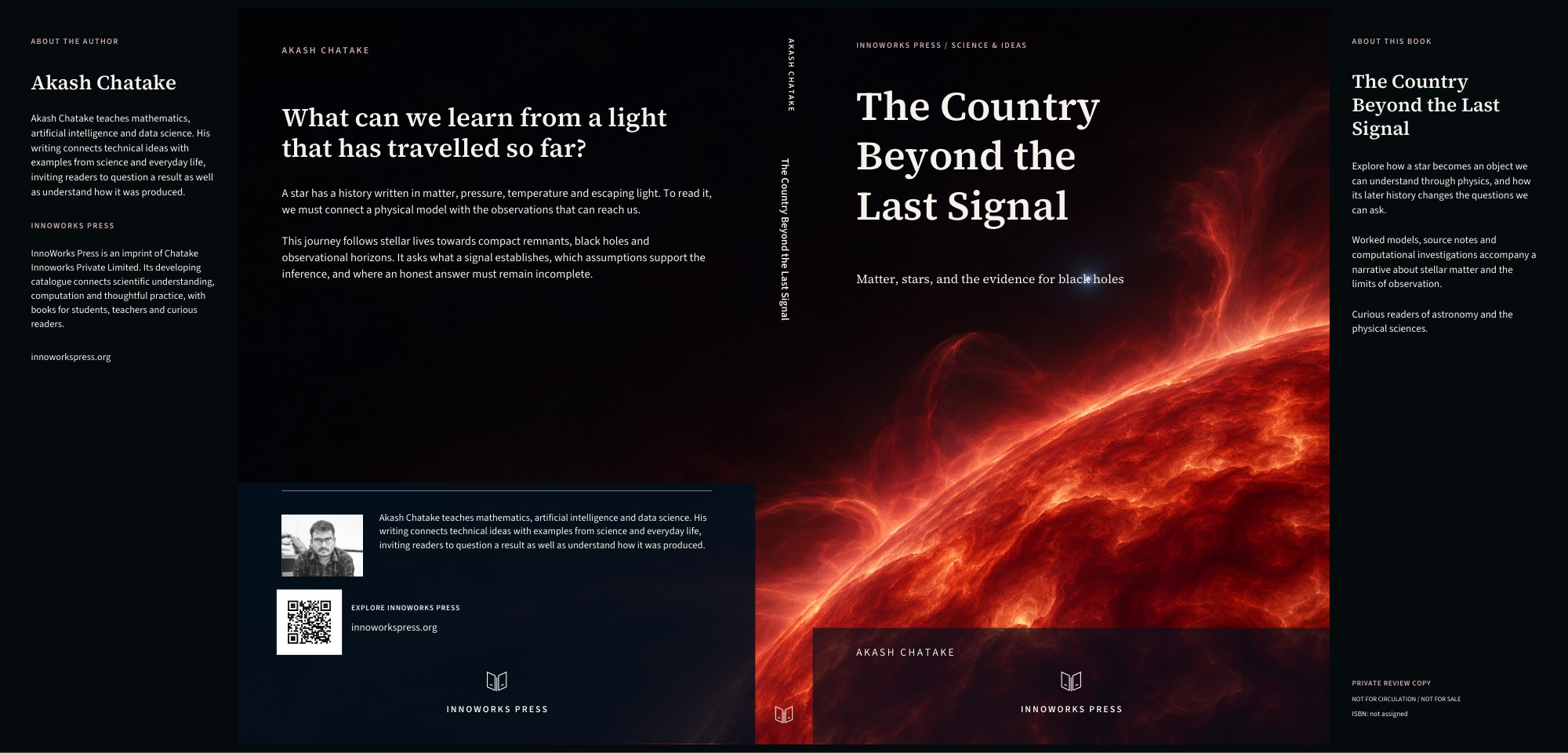
Cover and jacket
Selected artwork · design proofs