InnoWorks Press
INNOWORKS PRESS · REVIEW EDITION
Computing and systems
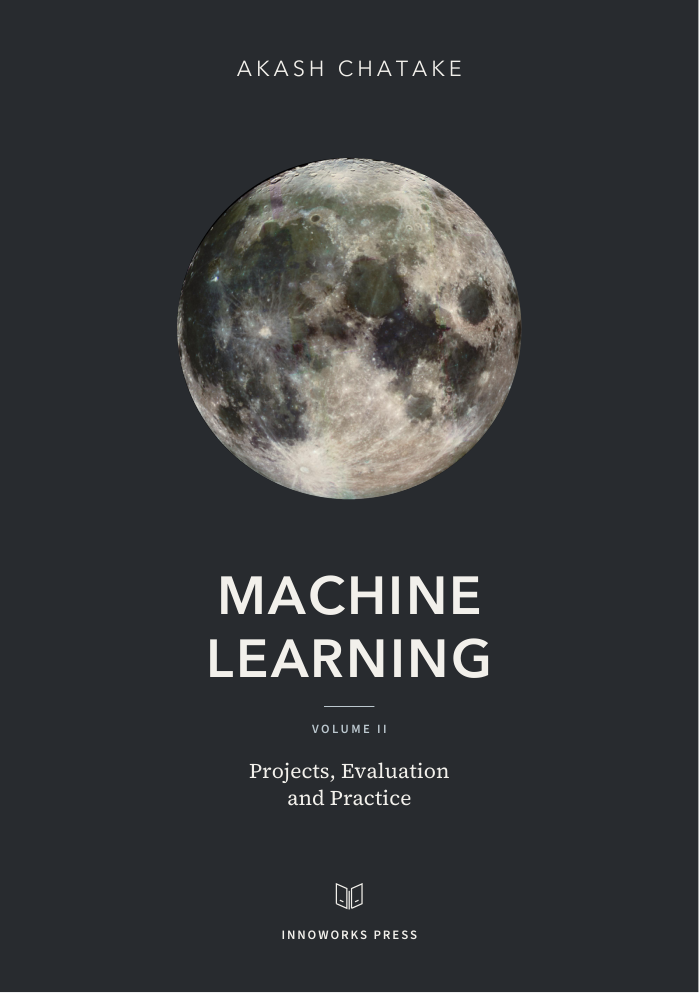
Machine Learning — Volume II
Projects, Evaluation and Practice
A model that runs is a beginning. A project must also explain its question, its baseline, the evidence used to choose it and the limits of its conclusions. Volume II carries the methods into end-to-end investigations, evaluation and the responsibilities surrounding deployment. Its extended references provide routes back into Python, mathematics, datasets, metrics and applications. The recurring discipline is to keep a record another person can inspect: what was measured, what was held back, what changed and what did not improve. Pair it with Volume I, or enter with equivalent experience and return to the foundations as needed.
Manuscript and companion under editorial and technical review. This local preview does not announce publication or sale.
Hardback · 978-81-184056-7-2
Paperback / softback · 978-81-184056-6-5
EPUB ebook · 978-81-184056-5-8
Inside the book
A route through the ideas
Who it is for
Students and practitioners extending their machine learning practice
- End-to-end projects: making an argument that another person can inspect
- Evaluation: how much should a result change our mind?
- Ethics and deployment: when a prediction enters someone else's world
Chapter titles follow the current review manuscript. Final pagination and edition details remain subject to review.
From the opening chapter
Begin with an idea
A graph appears. A score is printed. Several cells have run without error. It is tempting to call the project complete. Yet someone reading the result may still not know what was predicted, which information was available at the time, why this split was chosen or whether the reported score beat a sensible baseline.
An end-to-end project connects these decisions into an argument. The program records part of that argument, but the reasoning has to remain visible around it. A useful project should allow another person to reconstruct not only the result but the circumstances under which it was obtained and the limits of the conclusion.
This chapter develops three connected project designs: finding transit-like events in synthetic light curves, estimating a synthetic chemical-rate relationship and predicting a synthetic biological measurement. They are teaching experiments. None is presented as a discovery of a planet, a validated reaction model or a biological field result.
Beyond the page
Make the idea work
Read. Predict. Experiment. Explain.
Move between the explanation and a working investigation. Each chapter provides a question, inspectable code or a model, and practice that asks you to explain the result.
- Read the argument before running the calculation.
- Change an input or assumption and inspect the result.
- Explain what the model supports, and what it leaves open.
Chapter QR codes connect the print proof to these materials. The online edition is being prepared locally; public links require a verified release.
The book as an object
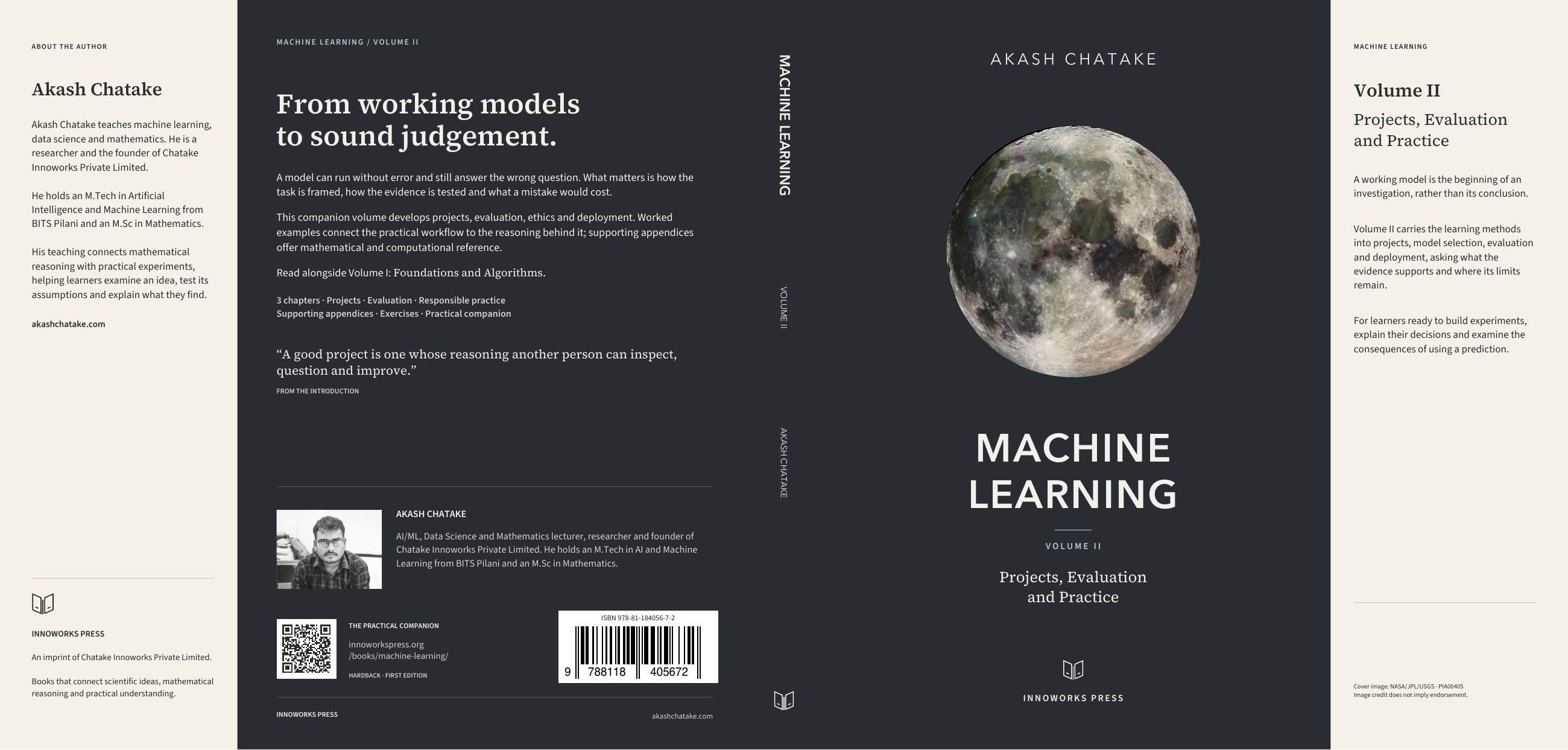
Cover and jacket
Selected artwork · design proofs