InnoWorks Press
INNOWORKS PRESS · REVIEW EDITION
Science and mathematics
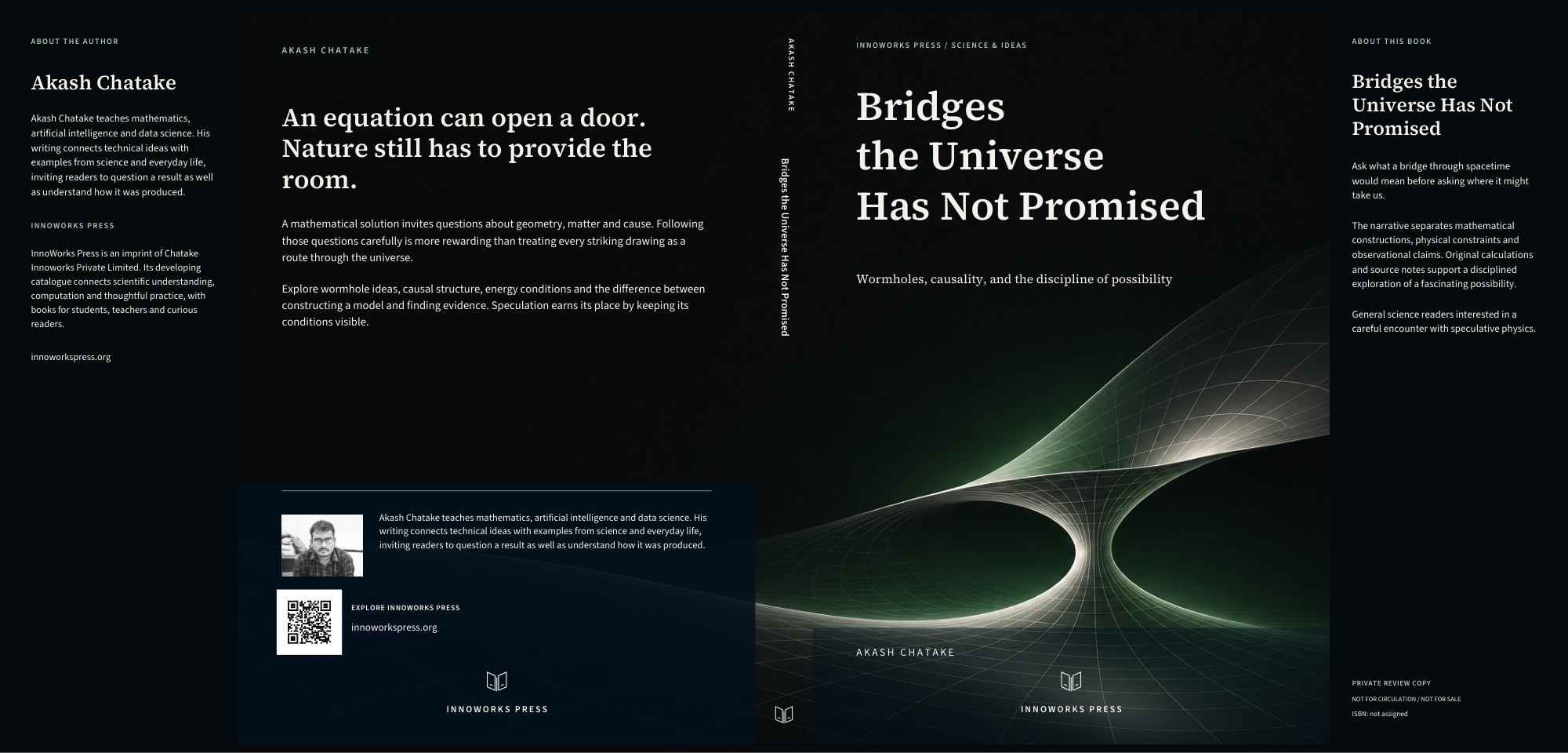
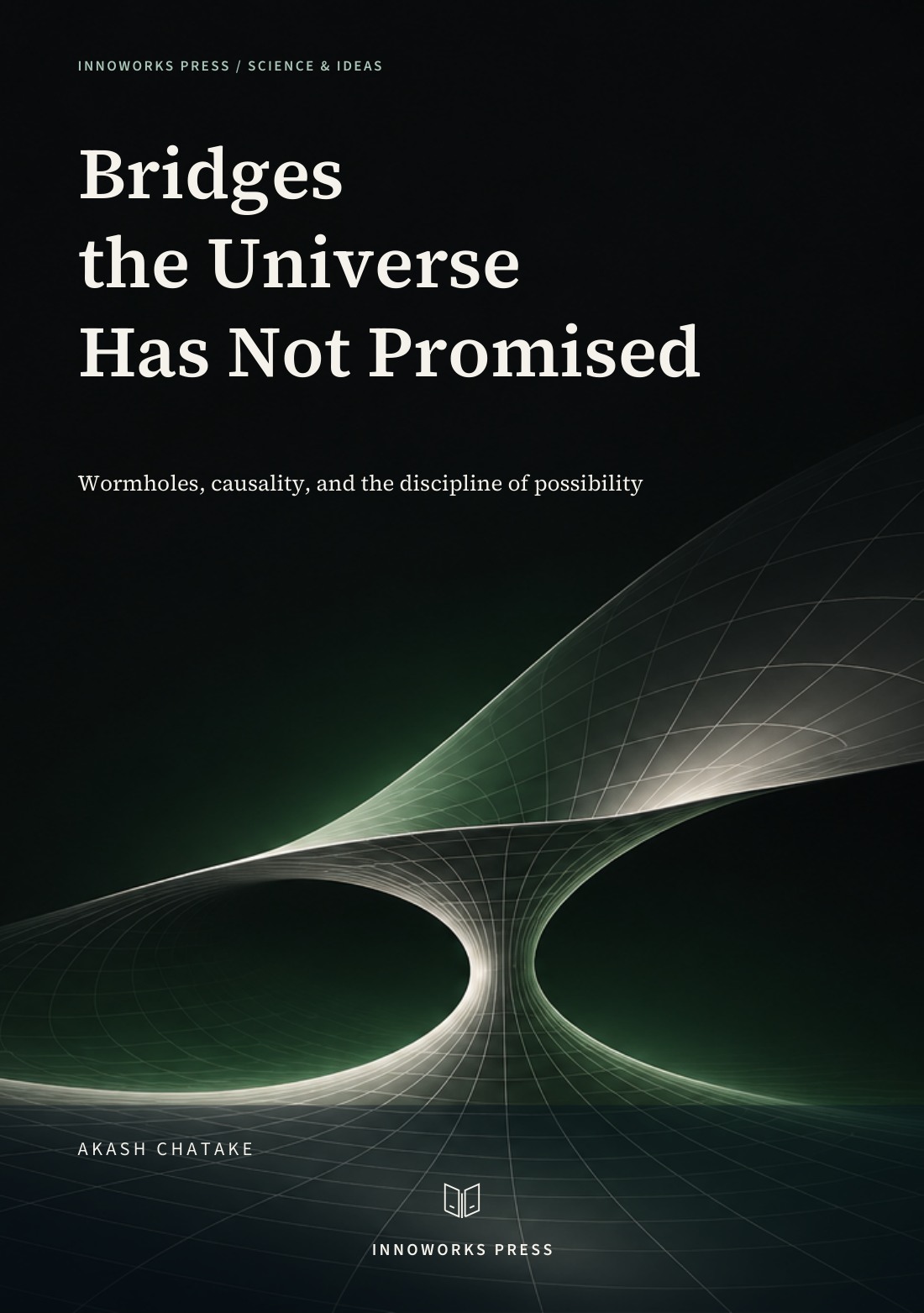
Bridges the Universe Has Not Promised
Wormholes, causality, and the discipline of possibility
A mathematical solution invites questions about geometry, matter and cause. Following those questions carefully is more rewarding than treating every striking drawing as a route through the universe. Explore wormhole ideas, causal structure, energy conditions and the difference between constructing a model and finding evidence. Speculation earns its place by keeping its conditions visible.
Manuscript and companion under editorial and technical review. This local preview does not announce publication or sale.
Inside the book
A route through the ideas
Who it is for
General science readers interested in a careful encounter with speculative physics.
- The door on the map
- Geometry without an outside
- A bridge is not a journey
- A throat drawn carefully
- The bill presented by geometry
- Quantum's small print
- A traveller is not a line
- The clock beside the door
- The laboratory and the metaphor
- What a promise would require
Chapter titles follow the current review manuscript. Final pagination and edition details remain subject to review.
From the opening chapter
Begin with an idea
On a desk lies a map of a mountain country. Two villages are close enough for a finger to cover both names, but the road between them climbs a pass, descends into a valley, and follows a river for hours. A tunnel would change the journey. So would folding the paper until the names touched. Only one of those operations, however, changes the actual country.
That is the first distinction this book asks us to keep. A drawing can make a shortcut look available before the physical world has supplied any means of making it. The folded-paper picture of a wormhole is memorable because it transforms distance in a single gesture. It is also dangerously efficient at skipping the questions that make the subject interesting: what geometry is being proposed, what matter would support it, whether travellers can pass through, how it might form, and what observation would count as evidence.
We will not begin by promising a tunnel between stars. We will begin with the desire for one. Ordinary distances are formidable, and local light-speed limits make that fact physically consequential. An imagination that asks whether there might be another route is not making a mistake. The mistake would be to treat the question as though its answer had already been delivered by the first attractive diagram.
Beyond the page
Make the idea work
Read. Predict. Experiment. Explain.
Follow a thought experiment into a small calculation. Change a condition, compare outcomes and keep the distinction between a model and the world it describes.
- Read the argument before running the calculation.
- Change an input or assumption and inspect the result.
- Explain what the model supports, and what it leaves open.
Chapter QR codes connect the print proof to these materials. The online edition is being prepared locally; public links require a verified release.
The book as an object
Cover and jacket
Selected artwork · design proofs